Generalized Tendinopathy treatment recommendation
This blog post tries to summarise the main points concerning the paper "tendinopathy", where coincidentally all things focus on tendinopathy.
file:///Users/felixschenk/Downloads/s41572-020-00234-1%20(1).pdf
In the upper extremity, tendinopathies in the supraspinatus within the shoulder (rotator cuff) and the elbow (common flexors and extensors) are the most common. Among these, rotator cuff impingement or subacromial pain syndrome, with or without tendon degeneration, is the most common8,9 . In the lower extremity, the most common tendinopathies occur at the heel (plantar fascia and Achilles tendon), the greater trochanter (that is, the gluteal insertional complex), the knee (patellar tendon) and theankle (tibialis posterior tendon).
Pain-provoking tests, such as single leg hopping for the Achilles tendinopathy, single leg squats for patellar tendinopathy and resisted extension of the wrist, index or middle finger or gripping an object for elbow tendinopathy, are useful to assist in confirming the diagnosis109
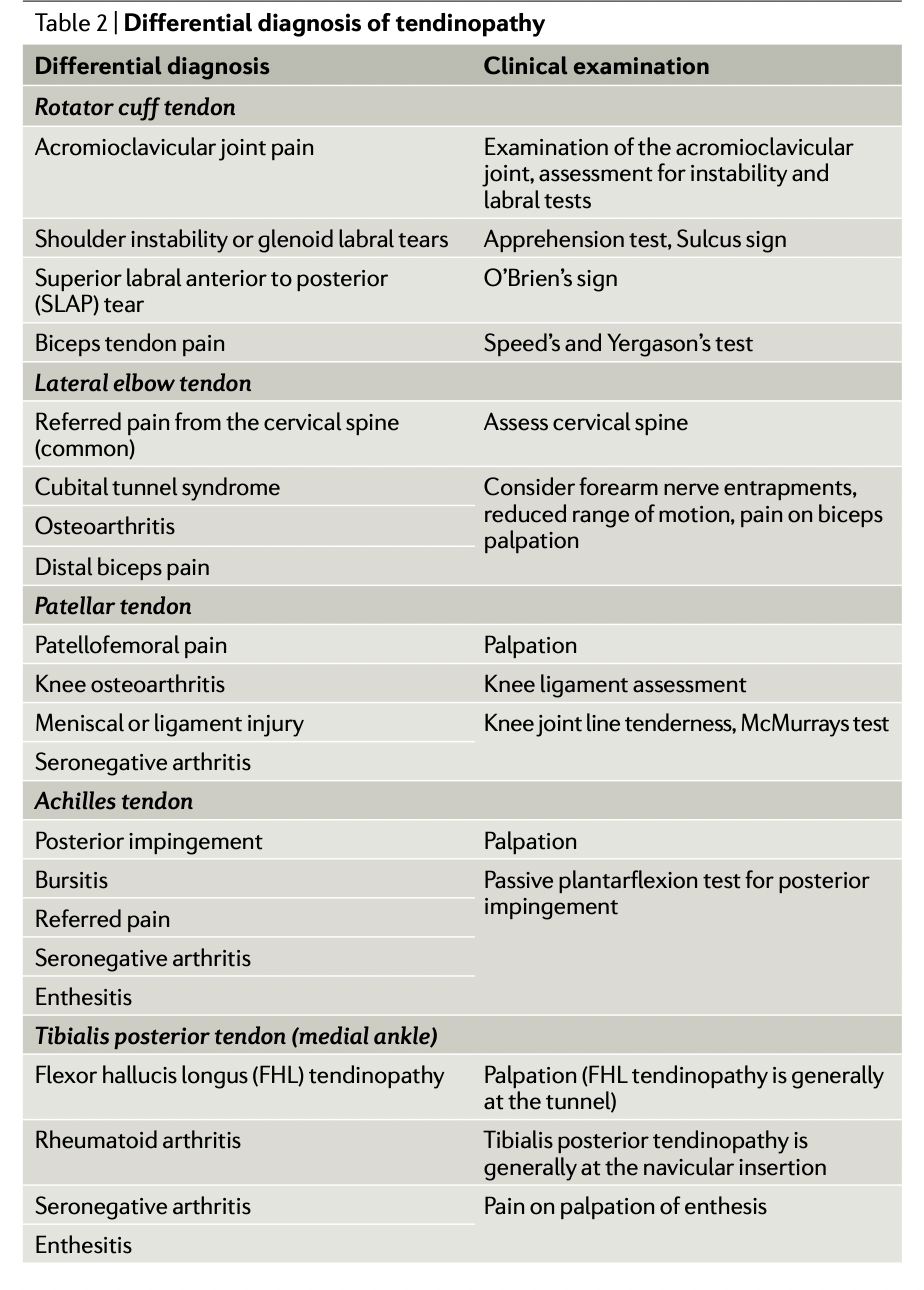
A detailed clinical examination that confirms a patient-reported history of load-related tendon pain and a physical examination are key to diagnosis. For those tendons that are easily palpable, tenderness to palpation is often used to confirm the diagnosis. Palpation is also useful to differentiate between other structures, such as painful fat pad with patellar tendinopathy or bursitis in Achilles tendinopathy, which might be involved in symptom manifestation108. In addition, there might be localized swelling at the area of the tenderness.
In patients with tendinopathy, soreness and stiffness in the morning or after being still for a longer period of time are common. A typical complaint in those with Achilles tendinopathy is having difficulty walking owing to pain and stiffness after prolonged periods of sitting.
The use of different pain-provoking tests (Table 2) can be helpful in establishing a diagnosis109. However, special tests of the shoulder, of which there are many, are no longer considered useful or valid for establishing diagnosis of specific structures, as these tests cannot isolate single structural entities111,112 and their use as pain-provoking tests is more appropriate112.
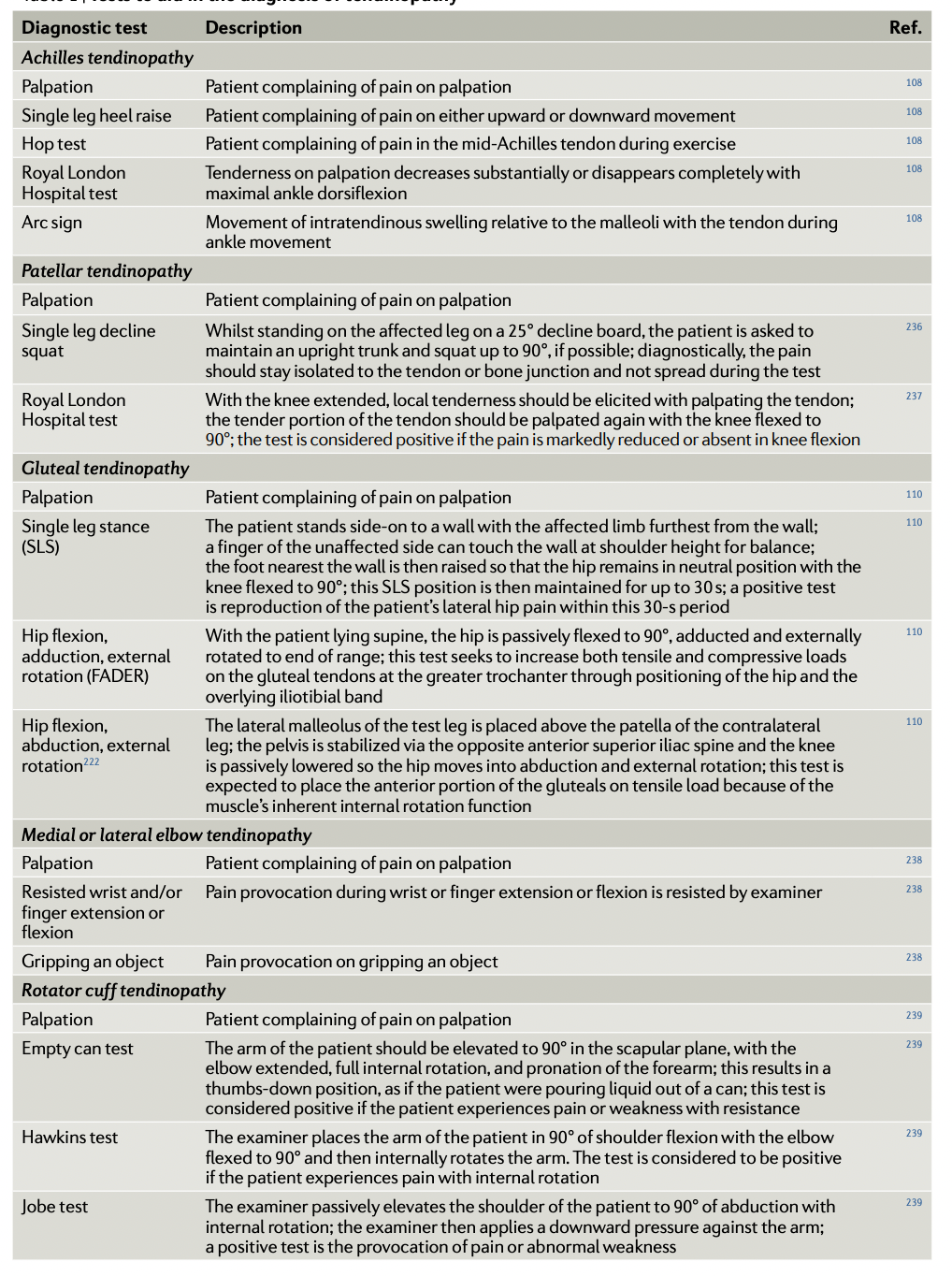
the presence of activity-related tendon pain or loss of function is required to fulfil the criteria for a diagnosis of tendinopathy.
Early detection of tendinopathy is paramount in achieving full recovery, particularly in the sporting population. Athletes have reported that early symptoms (that is, stiffness and pain at initiation of an activity but that disappears during the activity) still affected their performance. Notably, there is generally no pain at rest in the initial stages of tendinopathy and therefore the injury is often perceived as benign
, the Oslo Sports Trauma Research Center (OSTRC) overuse injury questionnaire115 can be useful to detect early symptoms and progression of symptoms.
Recovery from tendinopathy can take up to 6–12 months or longer, with shorter recovery times in those with less severe symptoms and tendon structural changes.
studies have shown that shoulder117 and groin118 pain in athletes associated with tendinopathy can be preventable by introducing specific exercise regimens aimed at improving strength and coordination of muscle tendon units in the shoulder and hip region. Indeed, exercise regimen have assisted in reducing the prevalence of shoulder and hip tendinopathy by 30–40% during the season in handballers117 and footballers118. However, loading programmes need to be carefully introduced; for example, the introduction of heavy loading exercise for athletes including footballers and volley ballers with patellar tendinopathy and Achilles tendinopathy during the season resulted in exacerbated tendinopathy symptoms (pain), as high loading was already ongoing
The therapeutic regimens can be divided into passive modalities, which include pharmacological treatments123, injection therapy, extracorporeal shockwave therapy (ESWT), therapeutic ultrasonography and low-level laser, and active modalities, such as tendon loading exercise, patient education and load management124. Different studies have investigated the efficacy of these different treatment strategies in isolation as well as in combination. In general, the efficacy of a treatment should be determined by the reversal of tendinopathy pathology and not just resolution of the symptomology
Currently, exercise regimens, referred to as tendon loading programmes, remain the most effective conservative approach in the treatment of tendinopathy (Fig. 5). Tendon loading exercises have shown beneficial effects in patients with chronic Achilles tendinopathy and patellar tendinopathy120,125. Studies of upper limb tendinopathies have further supported exercise training specifically for common extensor and rotator cuff tendinopathy126,127.
mixed contraction types provide benefit in the treatment of Achilles121,130, patellar131, gluteal132, lateral elbow133 and rotator cuff tendinopathy13
the decision as to which is the best tendon loading programme to prescribe should be an individual decision made between the prescribing health-care professional and the patient (whether it be eccentric loading, isometric or mixed contractions).
A dogmatic prescription of eccentric exercise for all patients with tendinopathy should now be replaced with options and principles of loading, instead of loading protocols. Engaging with patients and presenting treatment options will enhance the clinician–patient working alliance and optimize adherence to the selected programme, and this practice may play a large role in the success or failure of the prescribed loading programme135. The optimal programme might simply be the one the patient is most likely to perform.
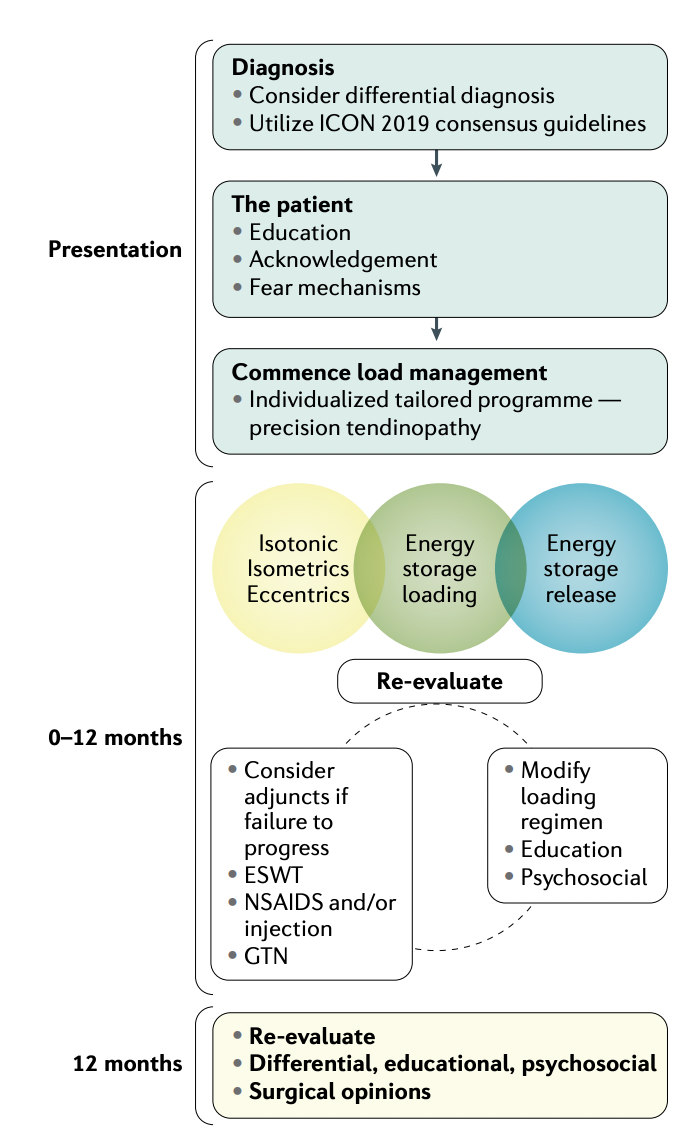
Management of tendinopathy. Early diagnosis is key and should consider a thorough differential diagnosis and the International Consensus (ICON) 2019 consensus guidelines107. A patient-centred and personalized approach should be considered in every case. Education on the disease process along with acknowledgement of previous unsuccessful treatments (if appropriate) and potential prolonged time frames involved in management as well as appreciation of fear mechanisms involved with commencing treatment should be undertaken. First-line treatment should encompass an individualized tailored loading programme, referred to as the precision tendinopathy management plan. This approach may include isotonic, isometric, eccentric, energy storage loading versus energy storage and release. Importantly, patient engagement and re-evaluation within a 3-month period is crucial to determine loading progression and consideration of adjunct therapies in combination with education and psychosocial factors. Throughout the ensuing months, revisiting this cycle may be required with further changes in loading programmes or adjunct therapies. Surgical intervention may be considered in the recalcitrant non-responders after 12 months of a personalized loading programme. ESWT, extracorporeal shockwave therapy; GTN, glyceryl trinitrate.
. Although evidence has confirmed the beneficial effect of loading programmes in treating tendinopathy, exercise is not a panacea. Thus, several issues linked to the specifics of tendon loading exercise programmes are yet to be clarified
In the past decade, studies have explored the effect of isometric exercises in the treatment of tendinopathy, in particular, its acute analgesic role. The pioneering study that investigated the analgesic effects of isometric exercises revealed a dramatic reduction in pain in patellar tendinopathy, and spear-headed further research into isometric contractions137. However, subsequent studies that investigated the acute response to isometric exercises in patients with patellar tendinopathy138, Achilles tendinopathy139 and plantar fascia pain140 failed to reproduce these results. Thus, further investigation is needed to understand whether and when to apply isometric contractions as an essential part of exercise regimens for tendinopathy141
A further study of HSR131 compared its effect with that of corticosteroid injections (CSIs) and eccentric decline squat training in patients with patellar tendinopathy, with similar results found across groups up to week 12, but by 6 months the two exercise groups (HSR and eccentric training) maintained improvements whereas the corticosteroid group deteriorated. HSR has also been studied in patients with Achilles tendinopathy and was shown to produce outcomes similar to those following eccentric exercises. Interestingly, the HSR groups reported higher satisfaction than those in the eccentric group, suggesting that options may need to be tailored to individual needs to ensure compliance and a beneficial effect of the treatment.
Performing tendon loading exercise can often induce pain, and patients report a fear of causing further damage when the exercises cause pain. In turn, this fear might prevent the patient from sufficiently loading the tendon, which might be necessary to cause meaningful clinical changes. Hence, informing the patient about the importance of proper tendon loading and making them aware that pain is allowed both during and after performing the exercises are a crucial part of patient education. The pain monitoring model can be used to facilitate patient understanding of the amount of pain allowed during and after exercise130. The pain monitoring model is a useful tool for the patient and also the clinician to determine exercise progression and plan the next steps. Randomized clinical trials (RCTs) have successfully employed the pain monitoring model in the treatment of patients with Achilles tendinopathy130,144 and patellar tendinopathy142. Discussing the response to exercise and highlighting potential side effects is a crucial component to success, and forging a therapeutic alliance and educating patients on the nature of their condition alongside realistic time frames may be critical to adherence and ultimately increasing the success of the intervention being prescribed.
even with the most effective treatment, after 12 weeks, individuals continue to have symptoms, such as pain or lack of return to full function. Studies with longer follow-up periods have also shown continued improvements up to 1 year1As the recovery and healing of tendons can take 6–12 months, it should not be surprising that many patients have not fully recovered at 12 weeks. In addition, one study found that tendon structural recovery does not occur until after 24 weeks150. The success and the rate of recovery have also been reported to correlate with the initial degree of tendon structural abnormality151. The exercise treatment might, therefore, need to be continued for >12 weeks, and patience is of great importance for achieving full recovery in patients with tendinopathy.
At present, clinicians should feel assured to prescribe progressive individualized strengthening that incorporates the current evidence-based principles of load and exercise progression for longer than 12 weeks when treating tendinopathy. However, as not all patients respond favourably to loading interventions, other treatment options should be explored as adjuncts or alternatives to tendon loading programmes.
A systematic review analysed the effectiveness of ESWT in the treatment of Achilles tendinopathy, patellar tendinopathy and proximal hamstring tendinopathy190. ESWT was superior to anti-inflammatory medication and physical therapy for patellar tendinopathy and proximal hamstring tendinopathy, and was similar to eccentric training for Achilles tendinopathy. A review evaluating the effectiveness of ESWT found that it is an effective intervention for alleviating pain and improving physical performance, and should be considered for the treatment of patellar tendinopathy and Achilles tendinopathy, particularly when other non-surgical treatments have failed191. ESWT for the treatment of tendinopathy in the upper extremity, particularly for lateral elbow tendinopathy, has also been studied extensively, and has been shown to lead to pain relief and improved upper extremity function with minimal treatment risks192,193
In addition to being associated with pain, tendinopathies have been shown to negatively affect quality of life, participation in sports and recreation and work, and to be associated with psychological stress, depression and anxiety in patients. The wide-reaching impact of reduced physical activity as a consequence of tendinopathy, and its impact on general health may be substantial. As depression and anxiety have been shown to correlate with pain217,218, failure to address these issues might negatively affect recovery and result in suboptimal outcomes in patients with tendinopathy135.
Loading programmes improve symptoms in certain patients, whereas in up to 30% of patients loading programmes alone without adjuvant therapies fail to resolve symptoms. It is incumbent on those involved in the management of tendinopathy — physiotherapists, sports clinicians and surgeons alike — to work together to identify how these patients can be best treated in the modern molecular era that medicine has entered