ACLR Rehab: The Complete Guide
In the following we will present you readers with answers to all common questions and misconceptions about rehab after anterior cruciate ligament reconstruction (ACLR) in general. Section 1 is for patients (and therapists) while section 2 will focus more in depth about rehab and is therefore recommended for therapists.
Structure of the following e-book:
- Overview - "How to think about rehab"
- System Thinking
- Early-stage
- Mid-stage
- Late-stage
- Return to criteria + when to start with what?
- Conclusion - "That's it?"
How to Think about Rehab
Overview
Thinking about Rehab
The current version of this e-book focuses on all things ACL rehabilitation (short: rehab) post ACLR. The rehab is structured in three stages / phases. Early-, mid- and late-stage. But more about that in the specific sections.
What this short section will be about is (how the title already spoilered) how to think about rehab. This might seem like a funny thing to say, but it is of utmost importance to get the most out of this protocol. The way I think about rehab is such: What is the end goal (or goals)? and what can the patient do now to get closer to that goal? That's it in a nutshell. Let me give you an example:
Patient X is a 34 year old male who enjoys taking part in the occasional tennis tournament near his town. He recently ruptured his ACL while playing with his friends on a weekend and opted for a surgical reconstruction. His goal is to get back to playing tennis on the level he was used to.
So how do we THINK about this case?
First things fist: What is the end goal? (apart from other possible things) is it that Patient X want to to get back to playing tennis.
Okay.
Then, what does one need to play tennis? Now we know that playing tennis is a sport that involves: lots of changes of direction (COD); fast accelerations / decelerations; quadriceps LSI of >90% and high endurance capacity (to name a few key aspects).
Now we take one of those abilities: say COD, and we break that further down. For a patient to be "allowed" to practice CODs, he needs to be able do first do some unilateral plyometric work and linear sprinting movements. Before that he had to perform bilateral plyometrics and below-maximum speed running. Before that he needed to build enough strength to tolerate (or be cleared to) jumping / plyometrics of any kind. Before that he had to walk without crutches and learn how to squat again with bodyweight only. And even before that he had to walk smoothly with crutches and show an ability to recruit the quadriceps muscle.
Now we can take any patient with the goal of participating in any sports that includes CODs and mentally think about all of these small steps. Where is out patient right now and what can we do TODAY to get him closer to that goal? If patient X was 5 weeks into rehab, could walk unaided, we are ready to start some specific quadriceps work (to get closer to the 90% LSI), underwater running (to get closer to the needed endurance capacity) and overall strength training (to be able tolerate future plyometric tasks).
Then from there, the next key point is to start plyometrics. How do we progress plyos? We start bilateral. When can a patient start with bilateral strength training. Once he can squat or leg press 150% bodymass. And patients are usually allowed to squat their bodyweight / leg press at week 2 and progress additional weight from there.
All this, the nuances of progressing exercises and more is going to be covered below. But it is crucial to learn to think with the end-goal in mind, and then split that goal up and mentally regress the end-goal as far back as needed into a movement or ability that can be trained right now.
With that in mind, each stage (early, mid, late) will start with the objective criteria that need to be hit in order to progress to the next stage. So in the beginning of the "Early Stage" section, there will be a list of goals that need to be achieved in order to progress into the next stage. And there, I too want you to think about rehab with these goals in mind. "What do i need to have my patient do right in this moment, to safely get him into the next stage?"
And just like that, we can have each session planned
Below you find a short overview of each stage:
General information about Stage-specific goals
- Early stage: Calm the knee down (reduce pain and swelling, increase ROM and muscle activation)
- Mid stage: Increase muscle strength and physical fitness; split up into phase 1 and 2 (phase 1 = high volume low intensity strengthening (15-20RM); phase 2 higher intensity lower volume strengthening (6-12 RM))
- Late stage: Maximise performance and prepare the athlete for RTS (fully normalise muscle strength, practice field specific tasks such as CoD, agility, plyometrics, RFD...)
As a general rehab principle: Think about local and global tissue capacity.
After an acute injury, local (=around the knee joint) tissue capacity will be drastically reduced (due to swelling, pain, immobility...). That's where a lot of focus will be laid on the global capacity (everything apart from that knee).
During the process, more and more focus will be laid on the knee, and in the end, everything will be back to getting the same amount of attention.
Overview:
Why does rehab after ACLR matter?
In short: the surgical procedure (ACLR) aims at only restoring mechanical knee function, while rehabilitation restores dynamic knee function. And it's about the dynamic knee function that people care about in their daily lives or during sports. Which can also be achieved with a conservative approach (but that's a topic for another day).
Below you will find a bar chart with some interesting numbers.
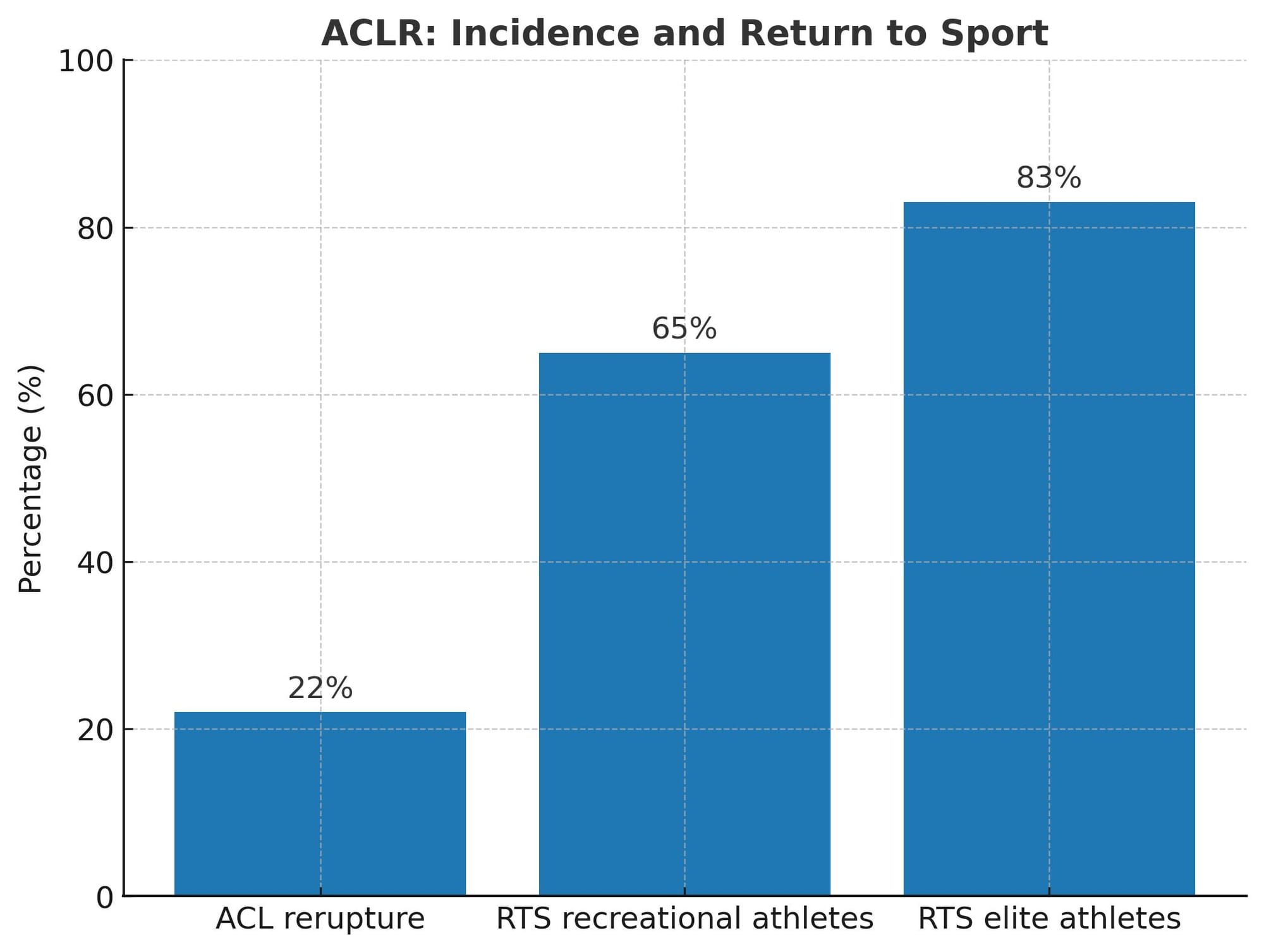
- Every fifth to fourth athlete re-ruptures their ACL.
- A meager two thirds of recreational athletes RTS
- And only 4 in 5 elite athletes RTS
These numbers (while they vary based on the study you are looking at) are here to illustrate one thing: there is no promised outcome after ACLR! You need to be aware of the fact that not every one of your patients will return to their previous level of performance after sustaining an injury to their ACL. And some times they will sustain a re-rupture. That's reality. While this might sound humbling, I do find the gap between RTS in elite and recreational athletes quite astounding. The debate is still open to whether elite athletes are simply better at compensating their injury or if they receive "better" rehab. But anyways, this e-book aims to enhance the latter and maximise the chances of providing top-notch ACLR rehab.
Let's get to it.
Side-note: 0
Pre-operative management is key for post-operative outcomes. Going into surgery the patient should have a quiet knee, with full extension, and >80% knee extensor strength.
System Thinking
Maximise outcomes from the musculoskeletal, cardiorespiratory and nervous system.
We will get to the nitty-gritty of each rehab stage shortly, but first we need to add another way of looking at rehab. System thinking. A way to look at different components of fitness (or health) that need to be included into rehabilitation. During each stage, the intensity and kind of training utilised that will elicit adaptations for the different systems will change. The overview will be provided in this section and will be revisited in more detail in each stage.
The Nervous System:
ACL rehab will focus on building capacities. But that kind of trianing differs from an actual athletic environment. For all of the chaotic and neurocognitive demands that are bound to happen during sports, we need to prepare our athletes at least in some way. By having them train frequently with neurally demanding exercises.
Neurocognitive interventions (Chaput et al., 2022):
Restoring balance is important in the early stage. Research has shown an increased dependence on the visual system for balance after ACL injury (Needle et al., 2017). Therefore, balance exercises that disturb vision, such as closing ones eyes, performing saccades or with virtual reality. This can be done during standing balance as well as while squatting or lunging.
Interventions to target the nervous system:
-> to progress the interventions, more difficult motor tasks can be integrated as well as more challenging assignments.
- Single Cognitive Motor Challenge:
"As you perform straight leg raises, count backwards from 100 by 7s.”
“As you perform your double leg squats, I want you to name all the professional basketball teams.”
“Perform a 45° lunge when you hear the command ‘ball’.” -> simulating a basketball pass
- Cognitive motor dual task (with decision making)
“When I flash the number 3, perform a forward lunge, when I flash the number 1 perform a curtsy lunge.”
“When the math problem sums to an even number jump left. When the math problem sums to an odd number jump right.”
- Object manipulation
“As you perform continuous single leg squatting, we will toss this ball back and forth.” -> add colours to the balls and let one colour be for the right hand and another color for the other hand.
“Dribble the ball in place as you perform a single leg squat and hold.”
- Perturbation
A quick manual perturbation to the patient is given during different exercises. Start at the trunk and progress to the extremities.
- Environment
From the silent clinic to the busy playing court.
- Object Navigation or Avoidance
“While performing this squatting exercise, don’t let the tennis ball contact you after it’s thrown. You may need to duck or shift your weight.”
Musculoskeletal System:
(Larson et al., 2021)
Assessments:
- Joint effusion:
Knee circumference (at 1 cm superior to the patella) and / or the stroke test (with a five-point scale: 0, trace, 1+, 2+, 3+; to compare effusion "that produces no fluid wave upon at the medial side of the knee upon the downstroke (effusion = 0) to effusion that cannot be moved out of the medial aspect of the knee during the upstroke (effusion = 3+)" (Larson et al., 2021)).
- Range of Motion:
Measure knee ROM with a goniometer and compare it to the other side. Be precise. As a lack of only 5 degrees in knee extension can lead to worse long-term outcomes. A patient should be able to lift of their heels while keeping the knee on the table.
- Muscle Girth:
Measure lower leg circumference 20cm above the patella to track quadriceps muscle less (especially). This can provide you with a clinically relevant metric for muscle cross sectional area of the lower limb.
- Muscle strength:
For quads:
Isometric measurement of knee extension with some sort of dynamometer (mostly hand-held ones, that can be set up appropriately to lead to reliable measurements of knee extension torque.
Alternatively, perform a 1-RM test at the leg extension machine. Although that might not be sensitive enough to detect smaller changes, you can definitively pick up larger muscle deficits.
For other muscles (calves, hip abductors, hip extensors, knee flexors):
Either do a set of AMRAP for each leg or do as many reps in a given timeframe (e.g. 3o seconds).
Additionally: do 1-RM tests of compound movements such as the squat or leg press, to compare to previous total strength levels (if pre-injury numbers are available).
- Rate of Force Development:
Pretty hard to test, but if force plates are available, RFD can be assessed by performing a mid-thigh pull.
- Reactive strength:
Reactive Strength Index (RSI) can be assessed during a double leg CMJ or drop vertical jump. This measure can be obtained by dividing flight time by ground contact time. Either with force plates or apps available for smartphones are just as reliable.
- Hop test:
Hop tests for distance (1 jump or 3 in a row) are easily assessed. But do not take the test results as a specific proxy for knee function. As ones body can easily compensate for the knee by increasing hip motion. So take it as a measure to assess a persons ability to hop, that's it. Compare both sides and look for any big differences in movement quality while doing the test.
Interventions:
ROM:
Why does someone have ROM deficits? Either due to muscle guarding, pain, swelling, arthrofibrosis or restricted patellar mobility.
For pain and guarding: manual mobilisations, massage or cryotherapy can help.
For swelling: pneumatic compression devices, adequate knee loading and active ROM
It is important for the patient to perform self-stretches more than once per day until full extension is achieved (have them apply overpressure, quadriceps activation in extensions, supine heel props, patellar mobilisations...).
What if knee extension limitations still persist?
Apply longer total end range time: have the patient do heel probs in supine with some external load (either manual overpressure or added weights of 2-6kg) and have them stay in that position for 10-15 min. They should do multiple sessions per day, so it adds up to >60min total / day.
Knee flexion ROM: aim for >90 degrees in by week 1 (post-op) and then progress 10 degrees each week after that (have them to wall slides, stationary bike, heel slides...).
For end range flexion, have patients perform heel sits (or adapted heel sits) a few weeks later, when other methods stop increasing ROM as much.
Strength training recommendations:
Periodization:
Linear, Nonlinear and block.
AMI needs to be addressed. As loss of muscle mass post surgery is not only due to disuse atrophy but also due to neurophysiological changes (e.g. changes in spinal reflexes). Therefore adding not only strength training but modalities that help address AMI is crucial.
Patients tolerance to load should be assessed via knee pain. The pain or soreness experienced during exercise, immediately after exercise and they after should be monitored. This helps to plan for adequate planing. Additionally measuring knee circumference (for a >1cm increase) or a higher result in the stroke test are important markers to see if stressors have been overwhelming for the tissues current capacity.
Supramaximal eccentric training has shown some promise to lead to greater adaptations compared to others.
For RFD: maximal strength training, olympic weight lifting derivates, strength trianing at different intensities with intention to move the weight as fast as possible (with the intent being more important than the actual velocity), plyometrics, accelerations / decelerations. And with the intent to move fast and explosively being so important "even an intervention such as a quadriceps setting exercise may be utilized with an RFD emphasis by intending to complete the quad set “fast and hard.”"(Larson et al., 2021).
Strength training should be taken seriously. And by that we mean it should be planned. For that we need to know how to program for hypertrophy, strength and power. As those are essential parts of a training program. Which is why you will find a cheat sheet for that here below to download:
Now, after knowing which training variables we need to change in order to get someone to adapt in a certain way, we need to periodise it. Periodisation is a strongly discussed topic and not something we are going to get into the nitty gritty of right now, but having some sort of set up in mind (from high reps to low reps, from low intensity to low intensity, from lower to higher volumes...) is key. A cheat sheet to do so can be found here:
Cardiorespiratory System:
The cardiovascular system takes a hit after every major injury. As a reduced ability to move normally leads to a decrease in cardiovascular capacity. Mostly due to a reduction in blood volume that is happening after 2-3 weeks of detraining. But getting back on track with cardio is essential. Not only due to performance factors, but also to reduce injury risk. As we described earlier, some ACL ruptures happen when people are fatigued (e.g. near the end of a soccer game) which means that by increasing endurance, we can get a better energy delivery to our muscular system and maybe reduce injury risk at the same time. As a 7-week pre-season training program showed just that (Heidt et al., 2000), with a combination of endurance and plyometric training.
Endurance can be increased via various methods. If a pre-injury measurement exists as a reference, great, if not, just do everything you can to increase endurance during rehab, to get the athlete back to sports as fit as possible. But as no criteria exist to clear someone for RTS that include an endurance aspect, it can be hard to know what to aim for.
Early Stage Endurance work (Seehafer et al., 2021):
- Aquatic exercises (walking, cycling, swimming without breaststroke kick)
- Upper extremity ergometer
- Stationary Cycling (bi- or unilateral)
- Elliptical running
- Battling ropes
- Sled drags
Once running can be safely commenced (see return to criteria) low intensity training (LIT) sessions of longer duration can be implemented. And once the athlete is cleared for higher intensity running (e.g. sprinting), high-intensity interval-training (HIIT) should be combined (2-3 sessions / week) with LIT.
Early Stage - Getting the Basics Right
From day 1 (to Week 4-6)
The early stage focuses on restoring basic functions of the knee that have been lost due to the operation, and to prepare you for mid-stage.
In the early phase, weekly improvements in ROM, swelling and muscle activation are expected. If a plateau is reached early in the rehab (especially in ROM) a consult with the surgeon might be necessary. Other complications that might sometimes occur in the early stage are:
Early phase complications:
- Deficit of passive knee extension (at 3 weeks post ACLR)
How to react: Create a program focusing intensely on increasing knee extension ROM. Consider bracing locked-in knee extension. If that doesn’t help, consider the execution of MRI (e.g. to rule out a cyclops lesion) and surgical options after a few months.
- Persistent moderate knee swelling and signs of inflammation
How to react: Make sure that loading is optimised for this patient (and it isn’t due to too intense rehab), medically start anti-inflammatory intake and try utilising a neoprene-brace and evaluate intra-articular aspiration.
- Surgical leg swelling, redness and soreness
How to react: Medical attention to rule out DVT (via doppler ultrasound of the lower leg) and check if the patient is receiving prophylactic therapy.
- Appearance of severe knee swelling, fever and other systemic symptoms (Important warning sign when swelling is increasing and not decreasing)
How to react: Immediate medical attention to rule out septic arthritis (antibiotic therapy would be indicated). Have them check blood markers (such as CRP), and assess synovial fluid (via aspiration).
- Delayed wound healing and superficial wound infection
How to react: Try decreasing the mechanical stress on the wound from movement. Avoid the wound getting wet.
Before getting into the fun stuff (about what you can and should be doing in the early stage) we have to name what goals need to be achieved to progress to mid-stage.
Early stage goals: (Buckthorpe et al., 2024)
Criteria to enter Mid-Stage: Must have
- Knee specific pain (NRS) ≤ 2 (while resting and ADLs)
- No (or trace of) swelling (via Stroke test: 0 or trace)
- 0° of passive knee extension (e.g. via prone hang test)
- >120° of passive knee flexion (via a goniometer)
- Sufficient quadriceps recrution (via: perform 10 repetitions of straight leg-raise with out a visible quadriceps lag)
- Normalised walking gait without crutches (via: visual assessment on a treadmill)
Criteria to enter Mid-Stage: Nice to have
- Good movement quality on a bilateral squat to 90°
- Knee extensor strength of >60% (limb symmetry index (LSI); via dynamometry))
- Knee flexor strength of >60% LSI
CAVE: A maximal VAS score of 4/10 is permitted during early rehabilitation.
ACL loading 101:
Exercise selection:
Progress from double-legged to single-legged
Progress exercises when technique is correct and symptoms allow for it
Regress when the knee has a flare up (increased effusion and pain)
Running can be initiated in the water, then in an alter-G (=anti-gravity) and then on a treadmill / field.
Although once an athlete is returned to running, running volume is going to be important to go up over time. To reduce chances of any flare-ups, before increasing volume you should have the patient perform aqua jogging / anti gravity running or performing lots of pogos in order to build up capacity. So that running itself is more likely going to be easily done.
Always think about adding or removing constraints in order to get what you want out of the exercise. If you want to athlete be better at pushing of laterally from the floor, add a resistance band that pulls them in the opposite direction, thereby increasing push of output.
Always measure the knees reaction to increased intensity:
- Swelling
- Pain
- ROM
these are crucial, to know when progression have been done too quickly.
How high are the ACL loads from different exercises? When should you be worried? (Escamilla et al., 2012)
Two rules of thumb:
- The ACL is loaded less during weight-bearing exercises than during non-weight-bearing ones (likely due to hamstring co-contraction).
- The ACL is loaded less between 50° and 100° compared to between 10° and 50° (due to quadriceps activity, where <60° of flexion, the patella tendon pulls the tibia forward = anterior translation, while in the higher knee angles (>60°) the force is directed posteriorly on the tibia, thereby relaxing the ACL). Highest forces on the ACL are happening between 10°-30° with NO ACL loading at knee flexion angles greater than 60° (Escamilla et al., 2012).
From that we can conclude: if we want to reduce loading on the ACL (which we obviously want during the early stage) we need to chose exercises that load the knee at higher angles and during weight bearing. If we opt for non-weight-bearing exercises, such as the leg extension (=probably the most important exercise for ACL rehab) then we can do them at angles <60 degrees and have no ACL loading there.
Knee flexion exercises have been shown to produce no ACL loading. Just be careful if the patient presents with a hamstring autograft. There loading should be kept minimal for the first 6-8 weeks.
When you start training the leg extension with lesser knee flexion angles, put the resistance pad closer to the knee joint, so that the lever arm gets smaller.
Squats:
Squatting puts minimal stress on the ACL (due to hamstring co-contraction) and the effect can be increased by leaning forward with the trunk. This puts more load onto the hamstrings, while unloading the quads. This is helpful for both double- and single-leg squatting and side-lunging.
Keeping the heels on the ground is important, as the knees traveling forward over the toes even in the high knee flexion angles increases ACL loading threefold and should be kept for the later stages.
Initially, when performing leg press (or squat), the knee flexion angle matters regarding ACL loading. In the early stage, use less load when going from 0 to 50 degrees and use higher-intensity loads for the 50 to 90 degrees range.
Cycling:
Research indicated that increasing cadence or power output (W) on a stationary bicycle does not increase peak ACL strain (Fleming et al., 1998). So using the bike early on for cardiovascular training is suggested. Cycling can also help to improve ROM of the knee joint.
Walking:
Peak ACL forces during walking are way higher than during weight-bearing exercises such as squatting, but to a similar degree as OKC exercises. Which means that if the surgeon allows for immediate weight-bearing, we can immediately start squatting (or once tolerable). And if full-weight bearing is allowed only after 3 weeks, squatting can likely be initiated at week two.
Jumping:
A 60cm drop jump (double-leg) led to ACL loading less than that of walking. How can that be?
1. Forward trunk lead recruits hamstrings (which are less active during walking)
2. Landing occurs at higher knee angles (if cued appropriately with "soft" landings) while walking is done at 10°-30°, which loads the ACL to the highes degrees.
This seems to be contradicting to the recommendations of Buckthorpe, who recommends bilateral landings only after achieving a 100% bodyweight single-leg squat, which does set a very high (and maybe too high) standard. But he talks about ground reaction forces, which can actually be 2 times bodyweight from such heights, and the body needs to be able to take such a load in a more controlled environment (e.g. slower movements like the squat) before progressing to more dynamic movements. So the recommendations of Buckthorpe, do not neccesarily focus on ACL strain, but on overall system capacity, that will be needed to tolerate higher volumes of plyometric exercises later on. So, in essence: do not be fearful of drop landings, as ACL strain is said to be less than during walking (only around 250 N).
Weeks 2-4 post ACL are when the graft is at is weakest, before re-vascularising and gaining strength from there on. So being careful until week 4 is important.
- Day 1 after ACLR: where do I start?
It is important for a therapist to look at the operated knee as early as possible, to make sure tissue healing is going as expected and complications such as DVT (deep venous thrombosis) or infection can be recognised early on if present.
Then, the early stage after ACLR has 3 main goals:
- Calm the knee down (=reduce swelling!)
- Activate the quads (this is key!)
- Regain full extension (flexion will usually come back on its own)
Out of these #1 is the most important one, as it can affect all the other ones. Swelling or effusion will limit knee ROM (thereby limiting full extension) and lead to AMI (arthrogenic muscle inhibition) and therefore holding back the quads.
How do we measure swelling?
- Measure knee circumference (above the patella)
- Stroke / brush test
Swelling should be assessed regularly (even daily). If increases in swelling are assessed after increasing rehab intensity, adjustments need to be made. Tracking a patient's activity (steps, quad activations...) can be crucial, to make sure the increases in symptoms are actually coming from the rehab sessions and not from other factors that you might be missing.
To effectively reduce swelling you can:
- Elevate the knee (put some effort into doing that, go for slight and comfortable elevation throughout most of the day for the first 1-2 weeks and 3 times per day get that leg into full elevation (60-70 degrees), up against a wall or something (don't be afraid of going that steep). Do that for 15-20 minutes and then put a compression bandage around the knee joint before taking the knee off the wall, so the fluid has a harder time coming back in). Perform aktive ankle plantarflexion and dorsiflexion throughout the day to increase blood-flow in that area.
- For additional pain management, the first 1-3 days you can put ice onto the painful knee, maybe in combination with the compression.
To activate the quads you can:
- Use NMES (neuromuscular electrical stimulation), to stimulate the quadriceps on a regular basis (helps to decrease AMI and improve strength), ideally with active contractions.
- Passive blood flow restriction (for the first few weeks).
- Isometric quadriceps activations (quad sets)
To regain full extension: (Full knee extension is not aimed at any degree or number, but should match knee extension of the uninjured leg. If the other leg has also been injured, then restoring knee extension to 0 degrees is the goal)
- Put something under your heel (when lying down or sitting) and keep the knee in the air, so gravity will pull it into extension. Only do this if it's pain free. If comfortable, you can sling a light backpack around your knee (or other weights on top) to give is some extra push.
- Actively extend your knee against a resistance band when sitting or in bed.
- If you haven't regained full extension after 2 weeks, invest time lying on your stomach with the knee in the air (gravity will pull the lower leg down = prone hang).
- While walking with crutches, focus on achieving an initial contact (IC) with an extended knee (+ roll the ankle through its full ROM, also during terminal stance, try to push off into plantarflexion to activate the calf muscles).
These above things are probably the most important things you can do in the first 6-12 weeks during rehab. In the early phase is less about doing more of the right things and more about doing less of the wrong stuff. So stick to the basics! and you are going to be prepare the knee just fine for mid-stage.
This viewpoint is supported by a 20 year old reserach paper by Grant and colleagues. They conducted a study in 2005, comparing supervised vs home-based ACL rehab, where the supervised group saw the patients 17 times during the first 12 weeks, while the home-based group did 4 sessions with a therapist during these first three months. Then, after this 12-week period they assessed for various outcomes, and found no big differences between groups, except for a small benefit for the home-based group regarding knee ROM (Grant et al., 2005). This trial also has a 4-year follow-up that showed no long-term differences between groups (Grant & Mohtadi, 2010). So we can go easy on our patients early on, without sacrificing long-term results (as in ACL rehab, it's about playing the long-term game). But, make no mistake: they did only see their patients 4 times (at the end of week 1, 3, 6 and 12), they all had to participate in a home-based exercise program. So they did do their work themselves. It is just to point out that giving them a few specific exercises, that fullfil the goals we set to reach mid-stage and have them progress every few weeks is likely enough early on to calm the knee down and prepare for the rest. This isn't sexy, but it's effective.
Who might benefit from training at home?
It needs to be underscored, that supervised exercise does not significantly outperform unsupervised exercise rehabilitation. Although the patient probably needs high levels of intrinsic motivation and discipline to keep pushing through the process. It is therefore not for everyone. But it's a viable option for some. Especially if rehab cost is a problem, a home-exercise program should be advised.
Van Melick and colleagues concluded in their 2016 review that comparing a 19-week with a 32-week rehab protocol led to no differences in knee ligament laxity, ROM and self reported knee function (Van Melick et al., 2016). Which makes home-based 19-week rehab likely a recommendable option for those that do not need to maximise performance.
Skin / Scar assessment (Lucas et al., 2021)
Localised warmth, redness and high levels of pain are signs of infection (most commonly after 4-10 days) and need to be recognised.
Sutures will be removed within the first 2 weeks of surgery, after that, steri-strips can be used to aid with tissue healing.
Scars can take up to 1 year to mature. The incision should be cleaned daily (especially for the first 2 weeks). Avoid entering public pools / rivers / hot tubs until the incision is completely closed (up to 1 month post-surgery). Add sunscreen around the scar to protect the skin for up to 1 year post-surgery (at least during summer time).
Gentle scar tissue mobilisations / massage seems to help with sensibility and mobility of the scar. Electrical stimulation is also a usable tool for that purpose, as well as regular use of emollients.
Kneeling (starting quadruped on soft surfaces) can be used to test skin sensitivity.
- Electrical stimulation (TENS), scar massage and emollients are recommended to promote adequate scar tissue healing (Lucas et al., 2021).
Tackling ADLs:
- Walking with crutches:
For the first 10-14 days it is recommended to walk in crutches. To help unload the knee joint, even if full weight-bearing is often allowed immediately post op. It is recommended to only weight-bear as tolerated. Once the gait pattern has "normalised" and full extension during gait is achieved with crutches, they can be removed safely (! there should be no increases in knee swelling of >1cm at the patella or increases in pain of +1 point shortly after the removal of the crutches).
Side-note 1:
Is gait retraining important?
In most cases: no. Because it is sort of illogical thinking. You have gotten yourself a pretty nasty knee injury, yes. But after a few weeks into rehab, pain will be mostly gone and knee mobility will be back enough for what you need during day to day activities. And usually (even after losing the mechanoreceptors that were inside the original ACL) patients will relearn walking just fine. At the latest after you put them in from of a mirror and have them look at themselves when walking, they will auto-correct everything they find "weird" about their currently new walking style.
In essence, the pain and functional limitations of the knee post surgery are as if you were having a stone inside your shoe. And when walking with that stone, it would be silly to say "oh no, we have to fix your gait, because it looks very strange". Just remove the stone and it's done. That's how it goes after surgery. Give the knee some time for the pain and swelling to settle and then the normal gait will come back on its own in most people.
There are exceptions when people after ACLR have a hard time walking without crutches, they can benefit from additional coaching (some corrective cueing), but most often, simply having them walk on a treadmill with a mirror in front of them will do the job just fine.
Key points:
Day 1 you will start walking with crutches as tolerated (if the orhtopaedic surgeon allows it).
You do not need to wear a brace, as outcomes have not been shown to improve from wearing one.
While still in the clinic, ROM machines are not worth your time, just actively work on flexing and extending the knee and you are more than good to go.
Start performing quad sets ASAP. Start with a few reps the first days and gradually work your way up until you do several hundred of them each day.
Alright, then: When can other exercises be initiated?
As you can see in the section below ("When can I start what?") closed kinetic chain exercises (CKC) can be initiated around 2-4 weeks post surgery. This means some sort of squatting motion could be started at week two. Good movement technique in these exercises should be achieved during the early stages of rehab, with similar limb loading (<20 % LSI) with a bilateral squat to 90° (measured on force plates, if available).
But: Before starting to squat, standing balance needs to be restored both bilateral and on one leg only. As this builds the foundation for more dynamic movements (such as walking, stair climbing...). Then squats, calf raises and weights shifts can be implemented and are also seen as pre-gait exercises.
The one sided weakness of the ACLR leg will inevitably lead into changes in exercise technique, which manifests as either altered intra- or intermuscular coordination. In a 2018 paper that looked at compensatory movements after ACLR they found that after 3 and 5 months post surgery, patients still showed compensatory movement strategies that led them to avoid using their quads (knee extensors) during bilateral squatting (Sigward et al., 2018). They did so by relying on greater hip extension force output while reducing the overall vertical ground reaction forces on the operated side. This means patients shift their weight towards the unaffected limb. These differences are sadly very hard to detect clinically, as they are influenced by a side to side difference of knee flexion of mere 3 degrees. So you better not be surprised that your patients will offload the affected leg one way or another, you have to expect them to do so!s
What does this mean? We should still be working on functional movements such as the squat, but just because the movement looks good, it doesn't mean that we are training the muscles we want to be training. Therefore, we cannot neglect isolation exercises (especially early on, go for a combination of leg extensions and leg presses).
Open kinetic chain (OKC) exercises can be initiated at week 4. But do so cautiously throughout the first weeks, to allow the knee joint and patellar tendon to adapt to the load. That might reduce the incidence of patellofemoral joint pain, which is quite common in this population.
Side-note 2:
Are OKC exercises safe?
If you are afraid of having your patients perform OKC exercises so early: they found 30 years ago that an isometric knee extension exercise, at 90 degrees of knee flexion, does not strain the ACL (meaning 0% strain) (Beynnon et al., 1995). So it's beyond safe to do them in this position. Then progressively working up to full extension over the next couple of weeks is reasonable.
Why perform OKC? Because a combination of OKC and CKC leads to better quadriceps strength gains (Kotsifaki et al., 2023) than OKC alone and a lack of quadriceps strength is a key limitation post ACL rehab.
Side-note 3:
What about the graft type?
The type of graft is of great importance for rehab. For example, a patient that has received a hamstring graft needs to be seen as a patient with ACLR in combination with a severe hamstring muscle strain. Therefore, progressive hamstring strengthening is a key aspect for these patients, as to not predispose them for future hamstring strain injuries (while keeping the hamstring-loading down in the early phase). Exercises of low intensities, at short and medium muscle lengths should be incorporated early (first weeks) and a more focused strengthening program, with higher intensities, after 6-8 weeks post surgery (to allow adequate healing of the muscle-tendon unit). While in people with a patellar-tendon graft (bone-tendon-bone), the incidence of patellofemoral pain might be increased.
Sometimes, patients are developing patellofemoral pain in the early rehab stages. In order to decrease that likelihood, strengthening the hip musculature (in extension, abduction and external rotation) is therefore strongly recommended.
Digression: Hamstring function (Buckthorpe et al., 2021):
ACLR utilising hamstring autografts can significantly decrease post surgical hamstring function.
Not only does reduced hamstring strength (reduced knee extensor / flexor ratio) correlate with ACL injury but do does ACL injury with future hamstring strains. Functionally, with their anatomical insertion at the tibia and fibula, they pull the tibia backwards, reducing ACL strain.
And a hamstring graft is nothing less than a grade 4 muscle-tendon lesion to the hamstrings, which needs to be treated accordingly.
Some papers suggest offloading the hamstrings for 6-8 weeks to let the tendon heal, but low load exercises (isometrics, mostly at short-to-medium muscle lengths) are recommended early on and then progressions can be made after the 6-8 weeks have passed.
Combine hip- and knee-dominant exercises to fully redevelop hamstring strength (for proximal and distal size gains).
Hip dominant exercises include: deadlifts, single leg-RLDs, single-leg bridge
Knee dominant exercises include: Leg curls (machine or swiss-ball), nordic hamstring curls.
Sprint training in late stage will work the hamstring muscles at high intensity and should be cautiously progressed.
Key point:
- Knee extensor muscle strength (=quadriceps strength) should be assessed with a dynamometer (at 90° or 60° of knee flexion) every now and then in order to track rehab progress.
In the early stage, high intensity training is not possible due to swelling, pain and AMI. Therefore, repetition ranges need to be increased (20+ reps). These sets should be taken very close to failure in order to elicit hypertrophy gains.
Exercises should aim at increasing muscle activation and strength of the targeted muscles.
Measuring pain levels and session RPE on a continuous basis combined with external load tracking gives a good ground for training progression.
Getting the quadriceps back is a big milestone after ACLR. As AMI leads to reduced quad activity due to a combination of pain and swelling. Making interventions that aim at reducing these two variables key.
To fight against AMI and speed up that process you can (Buckthorpe et al., 2019):
- Cryotherapy, compression and elevation. Have an athlete elevate their leg high, up, have the knee compressed and add ice (can help with pain and has been shown to reduce AMI after a period of 20-30min of cooling -> window of opportunity).
- Pre-activity TENS (transcutaneous electrical nerve stimulation) has been shown to acutely lower AMI after a 20-30min application session.
- NMES can help getting activation back in the inhibited muscle fibres (to be applied multiple times per day during the first weeks).
- Low load BFRT (blood flow restriction training)
- Cross-education (eccentically)
- EMG biofeedback of the involved muscle
In 2022 a small research group looked at all the evidence on how we can fight against muscle inhibition (most of them focusing on the quadriceps). In the following we will present the main points they made (Norte et al., 2022):
Daily work is needed and rehab should be initiated early post ACLR
Early Stage exercise selection:
For Extension:
Banded terminal knee extensions (standing)
Prone knee hangs
Heel elevations (with additional weight on top or with a band pulling down)
For Flexion:
Active knee flexion (with banded assistance, where the band pulls the leg towards the body) in supine
Standing knee flexion (= + hamstring activity)
For Quads:
Quad sets / pumps
Straight leg raise
NMES: should be provided for 6 weeks post ACLR to increase quad activation
Leg extensions (starting at 90 degrees in week 4, working your way up to 0 degrees at week 6)
For Swelling / Pain:
Elevate the leg (just a little throughout the day and then 3 times / day with a huge incline)
Play with ice (put an ice pack on and see if it feels good, for the first 2-3 days)
Side-note:
What about patellofemoral joint pain?
PFJ pain can be a problem after surgery but can be avoided with adequate load management. To do so, the knee tissues should be loaded while reducing PFJ forces. In CKC exercises, PFJ forces are greatest near full flexion, while in OKC exercises PFJ forces are greatest near full extension. And while OKC is "safer" in higher knee flexion angles anyway during early rehab, this fits in perfectly.
So around 4 weeks into rehab (when these exercises are usually started), OKC exercises will be performed at +/- 90 degrees flexion and the CKC (e.g. leg press) from 0 to 80 degrees, to load the knee while keeping PFJ forces low. Higher load exercises should be initiated after achieving 80% knee extensor LSI.
If PFJ pain is problematic, try patellar taping, as this can change the tracking of the patella and effectively reduce pain in some people.
Side-note:
Should you care about your athletes mental state?
Very much so.
Psychological issues such as fear of reinjury or lack of confidence in the leg and has been associated with decreased RTS participation. These problems can persist even after physical factors have been resolved.
Way more important that it might be perceived by most therapists are a patients self-perceived symptoms and function as well as psychological readiness measured at 6 months post-operatively, which are strongly associated with RTS at 12 months after ACLR (Webster & Feller, 2020). The association for these factors was stronger than other physical performance or muscle strength tests. Use the IKDC (International Knee Documentation Committee; for symptoms and function) and ACL-RSI (for psychological readiness) questionnaires.
For non-athletes, a nice and empowering way to improve these factors is to encourage people to participate in group training sessions (with ACLR patients). As the ACL-RSI index significantly increased after a 10 session group training program (which indicated better psychological readiness for sports). Although this is not for everyone, but those patients who are insecure and need a little push, helping them see that others are in the same boat, trying to get back to activities after a major setback can be a powerful tool. Especially for non-athletes, as this program involved progressive exercise progressions. So it may also be that the involved individuals had not undergone thorough rehab and these progressions helped them overcome their fears of more intense exercises (independent of the group setting) (Meierbachtol et al., 2018).
Side-note:
Why do we care about strength if it looks like they move perfectly?
Kinematics (the way someone moves in space) are dependent on the kinetics (force output) of muscles and joints. Therefore if the kinematics look fine, the kinetics should be too right? Sadly, we know that even if a squat looks "right" from the outside and even if measured on force plates and we see similar ground forces and weight distribution amongst the lower extremity, even then we people are capable to deload the quads and compensate with increased posterior chain activity. Therefore, we need to absolutely assess for strength deficits in isolation to get rid of any bodily need to compensate in the first place. By doing so, by making the kinetics right, we reduce the need for the kinematics to matter so much.
Side-note:
ACL injury mechanism:
A great cadaver study (Quatman et al., 2014) showed how knee abduction (=valgus), tibial internal rotation and anterior shear forces all led to increased ACL strain. While a multiplanar knee valgus led to the highest strains at a 25 degree knee flexion angle. While total axial loading is likely the main factors contributing to ACL tears, the knee flexion angle, internal tibial rotation, knee abduction moments and anterior shear forces (e.g. when decelerating) lead to increases in ACL strain. This shows that some biomechanical "deviations" do lead to increased ACL strain, but in order for that to lead to a tear, axial forces need to be high enough. Let's say ACL of X tears when 5000N are applied to it. So if X runs, plays on the floor... with knee valgus, then it doesn't matter regarding the ACL, because strain forces will be too low.
ACL Strain = Total Axial Loading + Knee biomechanics (flexion angle + knee valgus)
Knowing how to tear your ACL can tell you how to prevent it:
To prevent the ACL from tearing, proprioceptive training does not help you. As the tear happens in the first 40-50ms of impact (assuming a contactless ACL injury, e.g. from landing). So feed-back mechanisms are way too slow to react to such a quickly sustained injury, and therefore feed-forward mechanisms need to be adjusted for injury prevention. ACL tears happen at around 25-30 degrees of knee flexion (which is way less flexion than you think right now). Therefore, we need to work on learning athletes to use their knee flexion during landing so they get below the 30 degrees during the first 40ms of landing, while working on RFD to increase the muscles capacity to take some of the load from the get go.
The calves: an underrated muscle?
The soleus and gastrocnemius have been getting more attention in the recent literature, regarding ACLR. With an emphasis on the importance of the soleus in assisting the hamstrings to prevent excessive anterior translation of the tibia. Which is why it has been suggested to adequately train the calf muscles during rehab and include RFD and maximum strength measurement when clearing the athlete for RTS (Christman & Jayaseelan, 2025).
Early stage: Use all of the AMI strategies we also use for the quadriceps (e.g. NMES on the calf in supine with forefoot against the wall) and check for adequate dorsiflexion ROM.
Mid Stage: Strength and Hypertrophy training, as for the rest of the lower limb. Change foot angles to prioritise the medial or lateral head of the gastrocnemous more (e.g. medial head by turning the foot outward) and knee angles to target more of the soleus (90 degree knee flexion). Start with easy plyometrics.
Late Stage: Progress plyometric exercises for the calf complex, and include the ankle when looking at movement quality during agility drills.
In general, training will be progressed throughout the stages:
From working more isolated muscle strengthening (single-joint exercises) with a bit of movement pattern introduction, into more specific movement patterns (multi-joint exercises) with little isolation, into speed and agility work (while performing strengthening exercises besides).
#2 Cardiovascular System
Begin upper body conditioning on a ski ergometer (seated) and rowing machine (without legs). This is not only for the physical but also for the mental benefits, of the patients feeling like they are back at it again early on (3-4 weeks post op).
Bonus:
Exemplary early Postoperative Phase:
In the following we will use the proposed (and often optimistic) milestones of the study of Adams and colleagues from 2012 (Adams et al., 2012), with updates from the new Aspetar Clinical Practice Guilelines (Kotsifaki et al., 2023):
Week 1:
Goals:
- Knee ROM from 0 to 90 degrees
- Active quadriceps contractions with superior patellar glide
Achieved in practice by (=Treatment):
Full weight-bearing from day 1 with focus on correct gait;Active and passive ROM exercises for the knee from day 1 (0 to 90 degrees); Isometric quadriceps exercises (quadriceps pumps);Riding a bicycle for ROM;Supine wall slides for the knee;NMES;Patellar mobilisation;Straight leg raises
Week 2:
Goals:
- Knee flexion >110°
- Walking without crutches
- Stair climbing (foot-over-foot)
- Walking with full knee extension
- Straight leg raise without a knee extension lag
- Knee Outcome Survey activities of daily living (KOS-ADL) greater than 65%
Achieved in practice by:
Closed kinetic chain exercises such as body-weight squats (instead of isometrics); Continue with ROM exercises;Work of restoring normal gain function; Pain free range step-ups; Low-intensity scar mobilisation if needed (and skin is healed) Prone Hangs -> if knee extension deficits persist by week 2;Patellar mobilisation in flexion (if flexion is limited). Wall squat with uninvolved knee at 90° and the operated one at 60°. Standing heel raises. Single leg stance. Step-ups and Lunges with the uninvolved leg.
Week 3-5:
Goals:
- Knee flexion ROM within 10° of uninvolved side
- Quadriceps strength >60% of uninvolved side
Achieved in practice by:
At Week 3: Start leg pressing with half squats (to 45 degrees) for people with hamstring graft and start hamstring strengthening. At Week 4: Perform open kinetic chain exercises (such as leg extensions) in a restricted ROM of 90– 45°. At Week 5: Perform open kinetic chain exercises in a restricted ROM of 90-20°Progress bike and StairMaster duration to at least 10 minutes. Perform balance and proprioceptive exercises. Knee joint mobilisations (with rotations) if ROM is still limited. Standing heel raises. Single leg stance with eyes closed or on balance mat. Balance reach with leg or arm. Hip abduction / adduction training.
Week 6-8:
Goals:
- Quadriceps strength >80% of uninvolved side
- Normal gait pattern
- Full Knee ROM
- Minimal knee effusion
Achieved by:
At Week 6: Perform open kinetic chain exercises with full ROM. Progress intensity and duration of other exercises. Backwards and sidewards walking on a treadmill. Step ups and step downs. Lunges with weights. Single-leg stance while throwing balls.
Mid Stage - All about the quads
(+/- Weeks 6-12)
The mid-stage will help to restore movement quality, increase lower limb strength and overall fitness to prepare for late stage rehab.
Progression Criteria for Late Stage:
- Knee effusion: Zero effusion (stroke test = 0 and patella circumference <1cm difference)
- Knee joint ROM: full
- Before advancing to to late-stage, a LSI of > 80% knee extensor strength (or >2Nm/kg peak torque) and 80% LSI for knee flexors (>1.5 Nm/kg)
- CKC strength: 125% bodymass for 8 reps (on legpress) or 1.5 times bodyweight 1 RM
- Gluteal muscle strength: 20 reps on single leg bridge (< 5 reps side difference)
- Calf muscle strength: 20 reps on single leg calf raise (< 5 reps side difference)
- Single leg balance: >43 seconds eyes open and >9 seconds eyes closed
- Movement quality: Visually assess (take a video) of single-squat test
- Running gait: Normalised running gait
In short, the mid-stage has 3 main goals:
- Restore large strength asymmetries
- Restore movement quality (jogging, functional tasks)
- Physical fitness reconditioning
Side-note 4:
Why do we need peak torque measurements if we already assess LSI?
LSI (limb symmetry index) tells you how strong (or weak) your affected knee is compared to the unaffected one. So when hitting a 100% LSI, you know one knee matches the other in strength. But as Franco Impellizzeri once said in an interview: "if you are having two flat tires, comparing one to the other is not going to do much good", or something like that. But he made a point, that both legs could be "too weak" post-operatively compared to how strong they should be in an average athlete (at that age, in that sport). So getting some objective torque measurement in is key. So don't neglect training the unaffected side, to make sure it stays with having only one flat tire.
In the best case scenario, a pre-injury measurement is available (or at least knowing how heavy one could go to failure on a leg extension) to compare it to.
As bilateral neuromuscular deficits will be present after ACLR.
Because the weaker the unaffected side is, the easier it's going to be to hit the 80% mark. This would lead to a patient presenting with an adequate LSI, but low absolute strength. This might play a part in the high incidence of contralateral limb ACL tears. Especially deficits in early RFD are regularly seen (Mirkov et al., 2017).
In short: Train the unaffected limb, but with the aim of preserving, not increasing strength and size. Or else the problem will be the other way around, where the affected limb endlessly chases after the uninjured one in terms of LSI.
In the mid stage, we are looking to build up some capacity. Now more isolated (OKC) exercises (knee extension machine, but also leg press) will be implemented into the regime during the early period (and less squatting, deadlifting, lunging… to reduce compensation possibility in the beginning, but then they need to be incorporated to increase intermuscular coordination).
As mentioned above, patients need to be training both legs. In rehab this can be implemented easily by performing the same single-leg exercises on both legs, while utilising higher intensities, but lower volumes for the unaffected side.
For example: 6 sets of leg press for the involved side at 12 repetition maximum (RM) would mean 3–4 sets of 3–5 RM for the uninvolved side.
While the focus during this stage is on restoring quadriceps strength, we cannot neglect the hamstring musculature. Especially if a hamstring graft was utilised.
Some hamstring exercises have shown to target the medial hamstrings more than others (like the nordic hamstring curl) which you want to reduce early on and incorporate heavily starting at week 6-8. Otherwise include both hip and knee dominant exercises to target the hammies. But, targeted strengthening is usually delayed 6-8 weeks post-surgery to allow adequate healing of the tendon. Where then hip dominant exercises should be the focus at first, with isometric knee flexion.
Biomechanically, it makes sense to train the calf musculature, especially the soleus muscle. As it accepts not only a big portion of impact forces during landing from a jump but it slows down anterior tibial translation when the ankle moves into dorsiflexion. Thereby protecting the ACL.
Knowing that knee valgus (combined with high impact forces / axial loading) might increase strain on the ACL, retraining for adequate movement quality is indicated.
Closed kinetic chain strength can and should be used as a guide to decide when an individual is ready to initiate plyometrics such as bilateral landings, running and unilateral landings (more on that later). Before progressing to late-stage rehab, 1.5 times the patient's body weight should be put on a leg press machine by the patient.
Side-note:
How to measure the quadriceps index:
If there is no electromechanical dynamometer in your facility (which would be the best option) we suggest performing a 1-RM on the leg extension machine and compare side-to-side strength. As this has been recommended in the past (Noehren & Snyder-Mackler, 2020).
Knee extension machine 1-RM testing from 90° to 45° and handheld dynamometry with fixation via gait belt at 85° to 90° revealed the greatest accuracy for quadriceps strength estimation when compared with isokinetic dynamometers, closely followed by 1-RM knee extensions from 90° to 0° we advocate for frequent assessments of quadriceps strength utilizing isokinetic dynamometers or handheld dynamometry with fixation, if available, or via 1-RM knee extension strength testing in ranges of 90° to 45° or 90° to 0°. -> simply measure it in some way, to have some data to focus on. if 1-RM testing is too scary, use 5-RM.
Side-note 6:
Exemplary Squat progression:
Bilateral squatting will be progressed to a goblet squat -> split squat -> lunge -> step down -> single leg squat
Strength is not the only important aspect of mid-stage. We also need to increase the patients cardiovascular fitness. Aerobic capacity needs to be preserved during rehabilitation. How much and what kind will strongly depend on the athlete's sport (e.g. water running, cycling, cross-trainer). But adding sessions that focus on endurance and others that focus on upper body strength (or even core-training sessions) will lead to preservation of general physical conditioning, which is crucial.
Training Tipps:
For Strength: As the knee is still load compromised during this stage, lower intensities will be the starting point for strength training initially. Meaning 40-60% 1RM, with the aim of increasing intensity safely over time.
For Hypertrophy: Low load training to muscular failure is recommended.
The strength and conditioning program needs to be periodised. Intensity and difficulty should increase over time to challenge the athlete appropriately. This would mean starting out training around the 12-20 RM during mid-stage. So that metabolic stress will be leading the adaptation, while higher intensities are still contraindicated, as they would likely lead to pain and swelling (and maybe even loosen the graft).
That being said, the mid-stage can be further split up in two halves, seen as a sort of block periodisation, to increase intensity.
- In the first half, the athlete is load compromised and therefore, intensities will be lower (12-20) with a focus on non-weight bearing exercises (lumbopelvic-hip exercises) and machine-based workouts (leg press, knee extension). Other modalities such as NMES and BFRT (blood flow restriction training) are indicated to increase training effectiveness. While isolating machines are optimal to target specific muscle groups without giving the athlete a chance to compensate, we still have to incorporate other exercises with the main aim of teaching correct technique (as needed in sports). For that, if possible, acqua training, as well as deep water running is recommended.
- In the second half, training can be progressed towards moderately high intensities (8-12 RM) for the affected side. Also, weight-bearing exercises can be initiated not only as a means for movement quality, but to increase strength (through adding external load). Pool training (again: to be seen as an adjunct, for the professional athletes) can be progressed to single limb tasks and plyometrics.
Overall training recommendations:
Increasing muscle mass strongly correlates with resistance training volume. With more sets leading to greater hypertrophy than less. 10+ weekly sets are usually recommended to maximise outcomes.
Intensity correlates with strength. With higher intensities (>90%) being more beneficial for maximal strength and RFD increases than lower ones. While that is possible only in late stage rehab, exercises need to be adequately progressed (during each stage) to get back to that level of performance later.
This means starting with high volume but low loads and then slowly reversing the process to a lower volume higher load training.
Central adaptations after ACL injury:
After a tear of the ACL, central nervous system adaptations have been noticed and are likely playing an important factor in chronic AMI. Presenting as increased motor thresholds in the primary motor cortex. Clinically manifesting as muscle weakness (Needle et al., 2017).
With these neural adaptations the question is: what are we gonna do about it? We are simply going to train, right? Luckily, we have some similar research in the tendon literature, regarding treatment of tendinopathy. There, the focus during heavy resistance training is on external pacing. By using a metronome to guide repetition speed, they found that they could more specifically target cortical function (Rio et al., 2016). So it is worth a try, as it sure as hell does not hurt anyone to accurately have their repetition speed tracked by a metronome. If anything, it makes training sessions more precise and objectively measurable.
In my opinion, such a treatment add-on seems way to simplistic for such a complex problem, but it's worth a try.
Other modalities such as NMES, TENS, EMG biofeedback or even balance training have some research backing them and should be tried if available in the clinic (Needle et al., 2017).
Motor learning:
Implementing the right exercises for the right problem at the right time is what makes rehab challenging but exciting at the same time. The rehab process should always focus on a specific outcome, which will assist in creating a red-thread throughout the rehab process.
Differential learning aims to put the athlete in a different learning environment compared to what he is used to. There are two main categories to elicit change in the learning experience (which might be done if we do not get the outcome we want from our used approach):
Change in environment: train in water, on sand, on uneven grounds, barefoot, on a trampoline...
Change in the exercise set up: perform the exercise in a fatigues state, perform the exercises way faster or slower than usual, closed eyes
Plyometrics (mid-stage and beyond; based on (Buckthorpe & Della Villa, 2021))
(It is important to note, that while plyometrics aim at increasing explosiveness, they are not the only tool that can do that. Resistance training of any kind can also achieve increased explosiveness, when the movement is performed with the intent to move (ones body or the weight) as fast as possible during the concentric phase.
The impact forces of performing plyometric exercises can be reduced when doing them in water or on sand. To cue for short ground contact time + powerful push-off, say: "jump as quickly as possible, as high as you can".
To start with plyometrics, sufficient lower extremity strength needs to be developed. In this case, CKC exercises determine readiness for plyometric work.
For example: to run on a treadmill 1.25 body weight single leg press and 80% LSI and for unilateral plyometrics 1.5 times body weight single leg press (or squat) has been recommended (Buckthorpe et al., 2020).
Generally plyometric exercises are progressed from bilateral to unilateral tasks and from linear (vertical -> horizontal -> lateral) to multi-planar. As well as starting with more compliant surfaces, progression towards more stiffer ones (water -> trampoline -> sand -> grass -> indoor).
Progressions are made in line with pain (<2-3/10) and swelling (<1cm patellar circumference) as well as with continuous strength training progressions.
Looking for quality is important here, as we really want the patients to use their involved legs, without major compensations. This is also the reason why we need to have basic levels of strength before initiating plyometrics, because the lower extremity needs to handle loads multiple times the body weight.
4 Stages of Plyometric Training after ACLR:
Stage 1 = mid stage (typically weeks 10-14)
The program can start when an athlete surpassed the mid-stage entry criteria.
Exercises will be bilateral and GCT will be longs (1-2 seconds).
Volume will be 50 reps per session
Plyometric exercises:
- SJ (squat jump) to box
- Lunge pushback
- CMJ (countermovement jump) to box
- Skips in place
- Step up jumps
- Toe tabs (box)
Stage 2 = late stage phase 1 (weeks 15-18)
Stage 2 can be entered after achieving late-stage rehab criteria.
Maximal effort plyometrics are allowed.
Aim at achieving good bilateral drop jumps and single-leg deceleration control.
Volume 100 reps per session
Plyometric exercises:
- Bilateral SJ
- Bilateral CMJ (in place and forward)
- Bilateral drop jump (DJ) (no more than 30cm yet)
- Split jumps
Stage 3 = late stage phase 2 (weeks 19-22)
Volume 150 foot contacts per session
Aim at generating good control with the most important CoDs (on field) and single leg drop jumps.
If possible to control for it, try to gradually reduce ground contact times.
Plyometric exercises:
- Unilateral SJ and CMJ to bilateral landings
- Unilateral SJ and CMJ to box
- Rotational jump and land
- Lateral step and jump back (step/jump to one side and immediately jump back to the other leg)
- Tuck jump
- Step and cut (different angles)
- Single leg drop jumps
Consider different surfaces.
Stage 4 = RTS (weeks 23-29)
Volume = 200 foot contacts
Plyometric exercises:
- CMJ hurdles
- SJ / CMJ weighted
- Unilateral and bilateral DJ (increased heights)
- Lateral hops
- High intensity running dills on field
- On field CoD and agility drills (add external focus...)
- Jumps with external perturbations such as an elastic band or medicine ball
-> try to build reactive strength with plyometrics by cueing for short ground contacts.
General considerations:
To progress exercises, use pain and swelling as your guide. Track pain (NRS) and swelling (patella circumference, should not increase >1cm after exercise progressions) over time.
Overcoming knee extensor strength deficits (within 20% of the other side) is the number #1 priority of mid-stage rehab.
RETURN TO RUNNING criteria are found two sections below!
Late Stage and RTS - Performance
Returning to the Field (until week 24-28 and beyond)
In the late stage / RTS the aim is to improve neuromuscular and movement performance with a focus on sport specific training while maximising overall fitness.
RTS is described as a continuum:
1. Return to participation (=modified training)
2. Return to sports (=return to the same sport)
3. Return to competition (=return to the sport at the same level as pre-injury)
For elite athletes returning to their sports (e.g. football), Burhthorpe recommends:
RTS clearance:
- Quadriceps and Hamstring LSI of 100%
- Knee Flexor to Extensor ratio of >0.6
- Isometric RFD of knee extensors and flexors >90% LSI
- Soleus and Gastrocnemius LSI of >90%
- CMJ / drop jump / hopping performance of >95% LSI
- Qualitative movement assessment (e.g. LESS) on and off the field
- YoYo intermittent recovery test (for aerobic / anaerobic capacity)
- Agility T-Test for COD capacity
- 30m acceleration test, for speed capacity
- Progressive loading on the field, and getting 90% of the normal acute week workload of the team (ACWR of <1.5) to test for training load capacity
- Recover maximal running speeds and eccentric strength
Side-note 6:
When can i return to Sports (RTS) / Practice / Training?
This is a question any athlete will ask you sooner or later. And it's good to have an answer for it. We define RTS as the player being "allowed to participate in regular practice, without restrictions".
In the past, RTS was allowed no sooner than 9 months into rehab. As Grindem and colleagues have suggested the importance of implementing a combination of time-based and performance based RTS criteria in their often cited 2016 paper, stating that "simple decision rules can reduce reinjury risk by 84% after ACL reconstruction". They recommended the importance of delaying RTS at least 9 months after ACL-surgery (Grindem et al., 2016).
Any sooner than that, they found that reinjury risk increased. This was 9 years ago (while writing this: May 2025). Very recently Kotsifaki and colleagues gave Grindem's paper some pushback, showing that RTS time-point does not matter, as long as athletes are cleared with specific objective criteria (Kotsifaki et al., 2025).
So this is what we would tell an athlete asking "You will return to your sport once your knee is ready for it. You will have to go through a series of tests, and if you cut off well enough, you are free to go. But expect it to take +/- 9 months, as that is how long it usually takes for you to overcome these tests". So the 9 month mark has probably correlated with increased re-injury risk due to it being a surrogate measure for multiple variables (strength, tissue health, mental readiness...) associated with successful RTS.
We want to try to communicate that the 9 months that ACL rehab usually takes should be seen as an opportunity rather than a curse. An opportunity for the athlete to return better than he left, with a lot of time to work on things he couldn’t work on before, to refine his weaknesses and return with new energy.
Does that mean the athlete will not be on the field until then?
No.
RTS means unrestricted participation with the team. Until you get there, you will have been on the field for some time. Depending on the sports you are participating in.
Sport specific training can be progressed according to the Control Chaos Continuum (CCC) (for more information see papers here and here). And thereby progressing on-court intensity by starting with lots of constraints and slowly taking them away (at least for team sports athletes).
Have you ever asked yourself why training for maximum strength is always a criterion for RTS clearance? Even when it takes >300ms to generate maximal force output, but ACL injuries are thought to occur at around 50ms after impact? This means we cannot even use our maximum force to protect ourselves, as the injury happens too quickly. That's why it's important to test and train also for rate of force development (RFD), which is the ability to generate high forces quickly.
Training in the 8-12 reps zone, which is effective for building size and strength, has not been shown to be effective at developing RFD. To gain strength in the first 50ms after firing a muscle, strength training in the <5 reps zone, explosive training in isometric conditions and ballistic strength training (e.g. jumping or bounding) is recommended. Gains in RFD development can be seen after a few weeks of training like that and the increases can be quite significant. Explosive isometrics, ballistics, plyometrics and such should definitely play a part in late stage rehabilitation.
High intensity (>90%), low volume (3-5 reps) and long rest (>3min) resistance training seems to increase RFD to a good extend during the early contraction phase (around the 50ms mark) (Mangine et al., 2016).
Movement retraining might be important for some in the late stage, and not so much for others. Decide how much to focus on technique after you've seen the person move, not before that. If deemed necessary, opt for in person coaching, use biofeedback such as mirror training or EMG feedback or videofeedback. Progress movements step by step in a manner that challenges the athlete (not too much and not too little). Try tempo variations, such as adding speed or have exercises performed in slow motion, to give different inputs. The most important movements to look at include squatting, lunges, decelerations and change of direction.
Then again one might ask: why include movement retraining at all? Injuries like ACL tears do not normally happen while performing pre-planned movements in a controlled environment. They occur in environments that are chaotic, during complex movement tasks. Therefore, we believe that retraining for reactive movement quality seems of greater importance.
A players level of fatigue should also be played with during such exercises. As ACL injuries also happen when unanticipated movements happen in combination with high levels of fatigue (but mostly injuries happen early in the game). So do not have athletes practice important movements only when they are fresh, but also towards the end of an intense session. Buckthorpe said it well in his paper: "when athletes move optimally ‘on the feld’ in realistic sport-specifc conditions they can be considered to be ‘movement ready’ to RTS".
Then as we now know that fatigue plays a role, the question of how to best handle fatigue, comes up. We recommend to:
#1 Increase cardiovascular fitness.
#2 sufficient sport-specific participation and training before RTS.
#3 sufficient training in a fatigued state, so an athlete becomes accustomed to it.
On field rehabilitation should occur in combination with a S&C coach, to start with basic drills and steadily progress towards team training. The sooner athletes can return to the field (or their known sporting environment), even with the simples drills available, the better. This has been shown to correlate with improved RTS outcomes (and might be a boost for their emotional well-being).
How to Progress Exercises During Rehabilitation:
Exercise progression during rehab is more art than science. Fortunately, some useful models guide therapists in progressing exercises safely. One such model, presented by Glasgow and Blanchard in a 2014 paper, outlines a 4-stage framework for exercise progression and regression (Blanchard & Glasgow, 2014).
To illustrate, we’ll use the example of a basketball player returning from an ACL injury who has already passed the “return to running” criteria. We’ll focus on a sports-specific running progression.
Stage 1: Linear Running Progression
In this initial stage, the athlete will focus on progressing their running by increasing speed, duration, and frequency, among other factors. Here, the emphasis is on internal focus, with both the athlete and therapist concentrating on refining running technique.
Stage 2: Adding an External Focus
Next, the athlete will start running while holding a basketball. This introduces an external stimulus, requiring the athlete to pay attention to the ball, which brings the exercise closer to sport-specific training. This stage increases exercise demands with minimal added risk.
Stage 3: Diagonal and Lateral Running
In stage 3, we introduce diagonal and lateral running. To keep this transition safe, we regress by removing the basketball from stage 2. By taking away the external focus, the athlete can better concentrate on movement quality as they progress to more complex running patterns.
Stage 4: Combining Stages 2 and 3
Now we combine elements of stages 2 and 3, having the athlete perform diagonal and lateral runs while holding a basketball. This stage maximizes sports-specific demands, integrating multiple skills.
In the end, we can add other stimuli such as adding a throw close to the basket after dribbling there with diagonal + lateran running drills.
Summary: This progression/regression model is straightforward to apply and shows how a temporary regression can promote safe progression in the long term.
Movement quality (in depth): what matters?
When looking at sports performance, there exists no ideal movement pattern. When it comes to injury, the issue is not as clear.
We believe that we should think about movement quality differently. While it is most individuals move in an unique way and that uniqueness is oftentimes responsible for great athletic performances, we need to think about movement variability. In order to get someone the options to move differently in different situations / tasks, we need to give them the capacity to do so:
- Range of motion: check for movement restrictions (e.g. ankle dorsiflexion restrictions can lead to aberrant movement patterns) at and around the knee joint, to allow for free movement.
- Strength: Weakness in the gluteal muscles correlate with dynamic knee valgus, and knee extensor strength will (likely) limit someone in their ability to use higher knee flexion angles when performing a COD (as ACL ruptures happen and low knee flexion angles).
- Movement repetitions: have athletes practice CODs, decelerations... over and over again so a feedforward systems develops so that pre-activation of the musculature might assist in lowering joint forces.
ACL specific thinking would lead us to correct the presence of an "excessive" dynamic knee valgus. And by excessive we mean it should not be visible only on a slow-motion video analysis, but it should really stick out. As well as some form of knee-avoidance strategy, such as when a player hardly ever puts his whole bodyweight on the affected side and does not choose deeper knee flexion angles during jumping / plyometric tasks.
For completion, movement quality assessments should be done in a fatigued and non-fatigues state as well as during planned and reactive movement tasks (Buckthorpe, 2021).
If movement-correction is wished for, video-feedback can be very helpful, to shown the athlete which exact movements need to change. Helping them observe their own patterns and showing them the "correct" alternative is beneficial. When training this during practice it might cause contextual interference and lead to better motor skill development (when practicing one task in the context of another).
Acceleration, deceleration and COD tasks are of high importance and need to be trained plentifully before RTS.
Cardiovascular fitness needs to be restored to pre-injury levels as well. To reduce fatigue levels during play. VO2max measurements of pre-injury are great to have (but rarely accessible), so the average playing time and typical pre-injury workload with RPE ratings are fine to compare to how it was pre-injury.
Sleep and nutritional advice should be given and checked to make sure recovery is unfolding optimally.
Psychological readiness, confidence and overall knee status could be added to that already comprehensive list. Before releasing an athlete to their sport, they should have been training with or near their normal (chronic) training volume (made up of total distance, running speed, sprints...). As to not create a spike in the ACUTE:CHRONIC workload ration as they RTS.
Redeveloping maximal eccentric strength should be achieved in this phase as well.
Maximal effort plyometrics are indicated. To improve not only subjective knee function but also replicate demands of sports.
ACL injuries happen mostly during high horizontal velocities and not vertical ones. Making deceleration / COD and acceleration exercises more important than some jumping exercises, to prepare them. Getting the athlete back to these types of movements is crucial during the late stage.
Progress movements regarding intensity and complexity (from a movement quality standpoint) as demonstrated in the following diagram (Area #1 stands for early and mid-stage, #2 late stage and #3 RTS training):
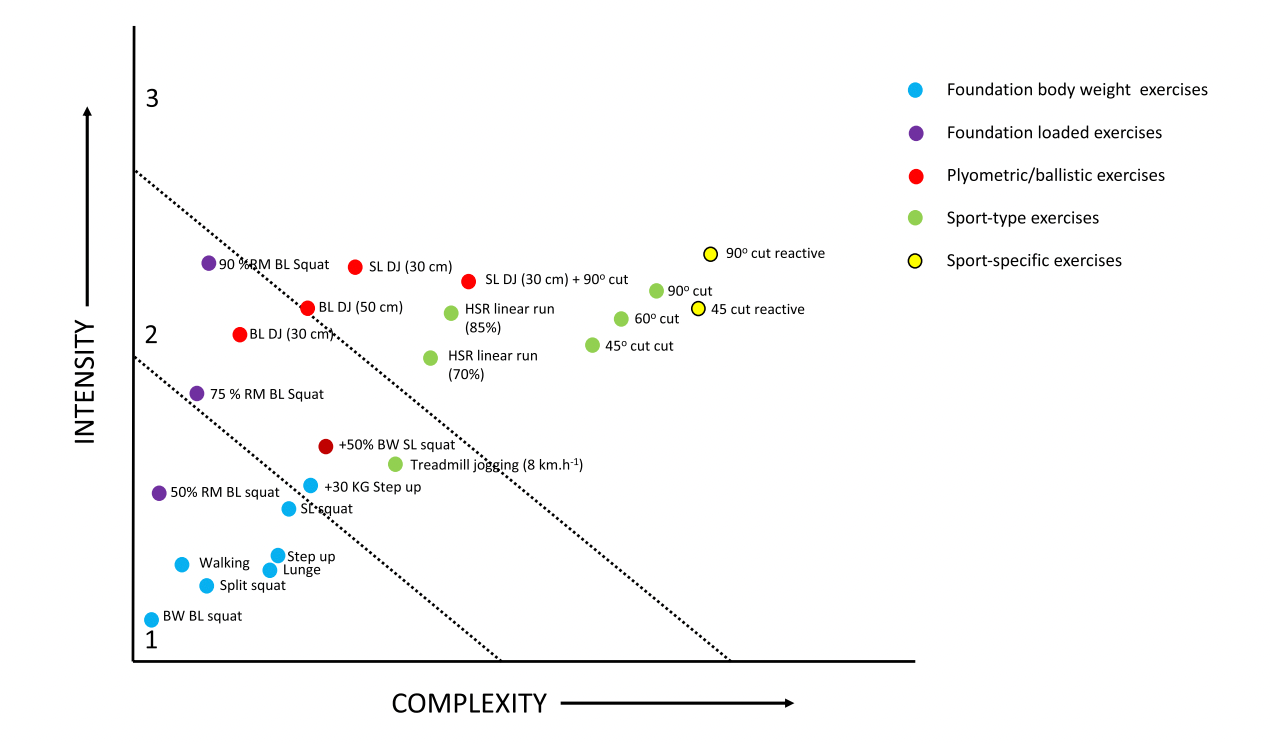
Progression criteria for plyometrics:
Buckthrope and colleagues created a task-based criteria list for different activites in the rehab process of ACLRs (Buckthorpe et al., 2020). One of them is the progression towards a single-legged squat. Which should be done only after hitting 100% bodyweight with the single-legged leg press. While the single-leg squat should be progressively implemented by starting with split squats, step ups and walking lunges.
As bilateral landings can reach 1.5-2 times bodyweight, patients should be able to produce that amount of force on a leg press, in a controlled environment beforehand. Exercises then would include submaximal jumps with focus on smooth landing.
For single leg landings, horizontal decelerations and single-leg plyometrics, the patient should have a quadriceps index (quadriceps strength) of 80% compared to the uninvolved side. The patient should also be able to move 1.5 times bodyweight on the single-leg press. Initially, single leg landings should be initiated from low heights and on soft surfaces (such as mats), and then be progressed accordingly.
The main points are summarised below:
Bilateral Landing
- Action: Control landing from a low-intensity jump using both legs.
- Strength Needed:
- 100% body weight (BW) for single-leg press
- 150% BW for double-leg press/squat
- Knee Motion Requirement: Flexion greater than 130°
Bilateral Plyometrics
- Action: Perform a two-legged drop jump from a 30 cm height.
- Strength Needed:
- 125% BW for single-leg press or 200% BW for double-leg press and 80% limb symmetry in knee extension
- Knee Motion Requirement: Full range
Unilateral Jumping, Landing & Plyometrics
- Action: Decelerate on one leg after forward or lateral running; perform a single-leg drop jump.
- Strength Needed:
- 150% BW for single-leg press and 80% limb symmetry in isokinetic knee extension
- Knee Motion Requirement: Full range
Checkbox:
OCK training for the quadriceps is not only save during early rehab, but crucial for minimizing late-stage knee extensor deficits.
Objective knee extensor strength measures should be taken in via some sort of dynamometry or 1-RM measurement on the knee extension machine. Do not solely rely on hop-tests or manual muscle testing for that purpose.
Specific adaptations need to be made according to graft-type.
Progressing from early- to mid- to late-stage should be based on objective criteria (swelling, pain, strength...).
When to start what and Return to Criteria
and Modalities explained
You can start with:
Immediately after Surgery (from the first day):
- Immediate full weight-bearing is allowed (Wright et al., 2015)
Recommendation: allow full weight-bearing only if there is a correct gait pattern. If not, stick to the crutches, until this goal is achieved. No pain, effusion or increase in temperature when walking or shortly after should be present (Van Melick et al., 2016).
- Immediate ROM movement (Wright et al., 2015), from 0 to 90 of flexion (Kruse et al., 2012).
Recommendation: Early extension training leads to a higher chance of regaining hyperextension of the knee. While anterior-posterior knee laxity is not jeopardised at the 2 year time-point (when using bone-patellar tendon-bone graft) (Isberg et al., 2006)
For improvements in ROM, active mobilisation exercises will be instructed immediately after surgery also to keep some muscle mass from vanishing. But while keeping in line with surgical instructions.
- Isometric quadriceps exercises (quadriceps contractions and straight leg raises) (Van Melick et al., 2016).
Isometric quad activations (quad pumps) and straight leg raises can be initiated in the first 2 weeks after surgery as it might bring small improvements in knee flexion outcomes when started early.
Week 2:
- Concentric closed kinetic chain (CKC) exercises (Van Melick et al., 2016)
From here on, CKC exercises should replace isometrics, given that that the knee does not react with effusion or increased pain.
Week 3:
- Isokinetic hamstring strengthening (Kotsifaki et al., 2023)
- Leg press can be done (half squats, to 45 degrees), in people with hamstring graft (Kotsifaki et al., 2023)
Week 4:
- Open Kinetic Chain (OKC) exercises can be performed in a restricted ROM of 90– 45° (Van Melick et al., 2016).
OKC exercises can and should be included from the 4 week time-point with no recorded adverse events. But therapists should be aware of possible increases in anterior knee pain and progress exercises within acceptable pain limits. (Kotsifaki et al., 2023)
Week 5:
- OKC exercises from 90 to 20° (Kotsifaki et al., 2023)
Week 6:
- OKC exercises from 90 to 0° (Kotsifaki et al., 2023)
Main Takeaway: The Aspetar guidelines recommend early mobilisation with weight bearing 3 days after surgery, when ACL injury is isolated. When other injuries accompany the ACL tear, like a meniscal injury, MCL tear... the weight-bearing instructions should be discussed with the operating surgeon. Of course, weight bearing is a therapeutic goal that should be accomplished early on, it still needs to go in accordance to the patients confidence in their knees, which takes a bit longer for some. But it should happen in the first week post-surgery.
Return to:
Return to Running: (Kotsifaki et al., 2023)
Before anyone is allowed to return to running they need to be put unter a jumping progression. We cannot emphasize the importance of that enough! Too often do we see people start jogging because the '4-month time limit" has been surpassed ... while we do not want to neglect time-based approaches, we would rather use them to set "minimal" time-guidelines that matches training
- 95% knee flexion range of motion (ROM)
- Full extension ROM
- No effusion/trace of effusion
- Limb symmetry index (LSI)>80% for quadriceps strength
- LSI>80% eccentric impulse during countermovement jump
- Pain-free aqua jogging or Alter-G running
- Pain-free repeated single-leg hopping (‘pogos’).
A time based approach is not recommended (but is kind of automatically embedded in the above criteria, because it likely takes >3 months to achieve them).
Return to training: (Kotsifaki et al., 2023)
- No pain or swelling
- Knee full ROM
- Stable knee (pivot shift, Lachman, instrumented laxity evaluation)
- Normalised subjective knee function and psychological readiness using patient-reported outcomes (most commonly the International Knee Documentation Commitee subjective knee form (IKDC), the ACL-Return to Sport after Injury scale (ACL-RSI) and Tampa Scale of Kinesiophobia)
- Isokinetic quadriceps and hamstring peak torque at 60°/s should display 100% symmetry for return to high demand pivoting sports. Restore (as a minimum) preoperative absolute values (if available) and normative values according to the sport and level of activity
- Countermovement jump and drop jump>90% symmetry of jump height and concentric and eccentric impulse. Reactive strength index (height/time)>1.3 for double leg and 0.5 for single leg for field sport athletes (higher for track and field)
- Jumping biomechanics—normalise absolute and symmetry values for moments, angles and work in vertical and horizontal jumps especially in sagittal and frontal plane at hip, knee and ankle
- Running mechanics—restoration of>90% symmetry of vertical ground reaction forces and knee biomechanics during stance during high-speed running and change of direction
- Complete a sports-specific training programme.
The 2016 RTS consensus statement paper recommended assessing direction changes as well as agility tests into RTS criteria after ACL injury. As well as assessing psychological readiness via the ACL-Return to Sport after Injury scale (Ardern et al., 2016).
In summary: fulfil the above listed criteria for a "as evidence-based" as possible return to running or sports, while adding psychological readiness and agility tests to the RTS criteria.
Testing:
Strength testing should be performed every 6-weeks. To control progress. But do not just randomly decide when you test them. This should be a well periodised effort, to display their current abilities as best as possible.
Return to Sports:
A successful return to sports is the product of the whole preceding rehab process. While hitting certain objective criteria seems to be protective and is strongly recommended, the whole process before that is what leads up to actually hitting these rehab targets. Below you will find a mind-map, summarising the whole picture that makes up a successful RTS.
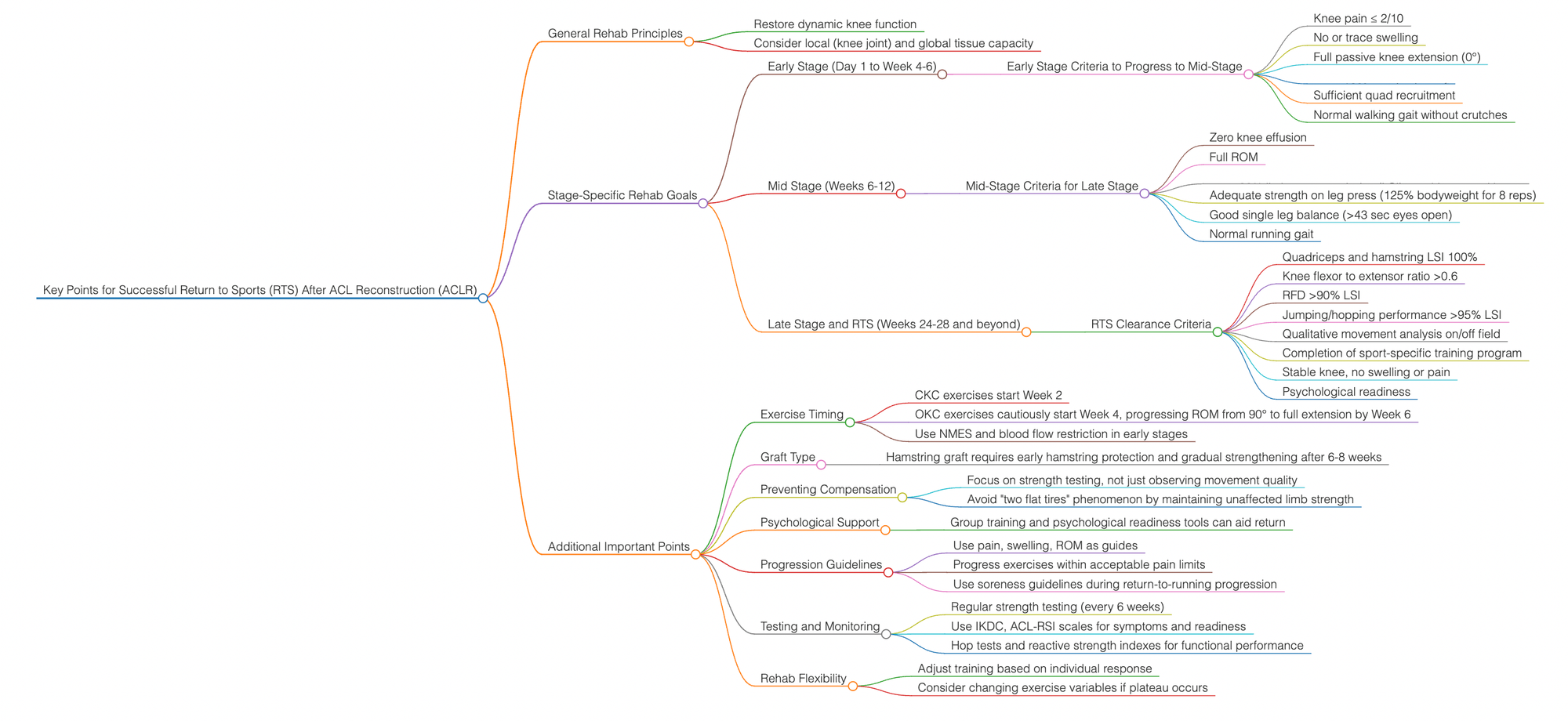
Treatment modalities:
Cryotherapy application could potentially lead to a reduced medication intake and decreased pain, although it had no effect on swelling. When compression is added (compressive cryotherapy), results were superior. Therefore, for the first 0-3 days post-surgery, compressive cryotherapy is recommended to increase patient satisfaction due to its easy to use characteristics. Although education on safe application to avoid adverse events is indicated (Kotsifaki et al., 2023).
Cryotherapy is effective in decreasing pain immediately after application up to 1 week postsurgery after ACLR, but has no effect on postoperative drainage or ROM (Van Melick et al., 2016)
NMES (neuromuscular electrical stimulation) has been shown to provide moderate effects on quadriceps strength and reduce knee joint swelling when implemented. Using NMES during functional activities led to better outcomes. Its application is recommended in the early stages, to work against atrophy. Should be used for the first 6-8 weeks (Kotsifaki et al., 2023).
Low load BFRT (blood flow restriction training) improves hamstring and quads strength in early stages. I can easily be implemented used as an addition to standard care. It is especially recommended for those with high levels of knee pain, who are unable to tolerate high loads (and also clarify possible contraindications, such as cardiovascular disease...) (Kotsifaki et al., 2023). In the included study, the limb occlusion pressure (defined as the pressure required for full arterial occlusion) was set at 80% intensity (Hughes et al., 2019).
Bonus: Adding some Nuance to Return to ... criteria
Will hitting all of these criteria prevent injury for sure? No, definitely not. But can you reduce the likelihood of it? Yes. Kotsifaki found that when objective criteria were successfully overcome, people were 5-6 times less likely to re-tear their ACL than those who RTS without passing these criteria. And are we sure that these criteria are the best? No. But they have been shown to reduce the risk. Adding a test or removing another might be possible (depending on which test we are talking about).
When it comes to hitting 80- or 90% LSI, what about the athlete hits 78% or 89%? Well, it depends. These values have been chosen because researches found these cutoff points to be the fine line between lower and higher injury risk, so in my opinion, if possible, try to hit the exact number. But again, when we think about complex systems, then we know that these factors might be less relevant if we take notice of other variables. For example if an athlete really wants to RTS due to financial pressures and has a LSI of 87% but also has a mental readiness score that is flawless, then the chances of having this player participate without getting a re-injury are going to be higher.
Without further getting off topic though, it is nuance that is important when making these decisions. And a single factor should not be holding someone away from RTS, but a combination of them could.
Conclusion
That's it?
If you apply all (or even most) of the above described frameworks, training tipps, progressions, time-frames, return-to-checkpoints and so on ... there is still not a guaranteed outcome. We humans are as different from one another as it gets. And this here we are not trying to be dramatic, but saying that sometimes, to achieve a certain outcome, the approach needs to change. As Einstein (allegedly) once said:
"Doing the same thing over and over again and expecting different results, is the definition of insanity."
So what do we do if we are stuck with a patient at a quad index of 70%? What do we do if strength plateaus even if we stick to the "optimum" intensity / frequency / rest ...?
We need to change what we are doing. First, look at what might be going on. Take a step back. Is there something you need to consider? Any red flags that might be popping up? If not so, and training has been going well, then we need to learn to deviate from our known standards and try things. Maybe we need to swap out the exercises, increase repetition ranges (even if that would not be considered ideal strength training no more) but maybe that's just what the patients responds to best. Sometimes, we need to look outside the box and try stuff that might not be considered optimal for most of us (which is what most recommendations stem from: a mean average) and try something new, it might just be what the patient responds to.
A few numbers to interpret:
Recreational athletes: Return to sports rate of 62% (to previous level sports)
Elite athletes: Return to sports rate of 83% (to previous level sports)
How can there be a 20% difference in RTS between elite and recreational athletes? It is not sure whether this huge gap is due to athletic skill of the individual (maybe elite athletes have higher abilities to adapt to their bodies "new" circumstances?) or if rehabilitation in those settings is doing as much of a better job (with more evidence-based prescription and higher compliance of the patients). Who knows. But we know that there is a gap to fill and not everyone (even in the elite setting every fifth player does not return to their previous level!) will RTS. That's just the harsh reality that we need to keep in mind and we need to communicate to our patients as such. Not in a pessimistic manner, because to date no good predictive measure exists to tell you who is going to make it and who isn't. We do not yet have good data to tell us about the characteristics of those who do not return to their previous level of activity. But it is very likely that adhering to structured rehabilitation program will increase the odds to get a patient back to their desired level of activity!
When discharging a patient, should we give them some kind of prevention protocol?
2018 paper on ACL injury prevention recommend the "implementation of exercise-based ACL injury prevention programs in athletes 12 to 25 years of age and involved in sports with a high risk of ACL injury" (Arundale et al., 2018). Although we still do not know the exact mechanism through which prevention programs lead to reduced injury risk, it is likely due to gains in strength. Therefore adding 20 min session 3 times per week, with a mix of strengthening and plyometric work has been recommended.
Looking at injury prevention programs, a recent meta-analysis found that a combination of plyometrics, strengthening, and agility exercises are needed to create an efficacious ACL injury prevention programme (Huang et al., 2020). Coaches and therapists have enormous flexibility in designing these programs, as long as exercises from all 3 of these categories are included. Another important seems to be providing athletes with feedback based on their movement technique. This should be done by experienced coaching staff. In summary, chose exercises from the above 3 categories + technique coaching in some way (visual, verbal, video, by teammates...) and you should be good to go.
Last, but not least I do want to tackle a fallacy regarding the ACL and mechanics general:
A often cited number in the literature is 2,160 Newton. Which is the amount of force needed to tear the ACL. Lets say a person who weights 80kg lands single-legged from a jump that leads to a ground reaction force of 6 times body weight (not something unusual in athletes). This would lead to (80 x 6 = 480; 480kg x 9,81m/s = 4,700 N) 4700 Newton of force that goes through the body, and also through the knee joint. So you say: such a movement HAS to tear the ACL. Wouldn't that make a lot of sense? Well, it would, if we were talking about a passive system. But we are talking about a human body. Where different muscles and joints do act as shock absorbers, distributing the total load throughout the whole body and not just into one ligament.
But, if, as we saw in the above mentioned cadaver study, the person did not just land "normally", but landed in a valgus knee alignment, then it would increase the load accepted by the ACL and increase the likelihood of sustaining an ACL tear. Correct. So mechanics do matter a lot right? Well, not so fast. Mechanics do matter sometimes, especially if they are very obvious (meaning that it looks really really bad). But like we said above, we are not talking about a passive system. We are talking about humans. And like I just mentioned, muscles do take load off the joint. So if we can increase the muscles capacity to take load, we decrease the load on the ACL, just as if we "cured" mechanics, that "might" increase ACL load, but might also just be the important thing for the athlete, that makes them exceptional. And for this thought process I need to give credit to Erik Meira and quote his blog, as I couldn't say it better: "with enough muscle activation, THE MECHANICS DO NOT MATTER". So that wraps up the mechanics fallacy. Even though mechanics do matter, some times, they do not matter all the time. And it is probably better to focus on building capacity in your athlete than to make him fearful of moving the way he was used to his whole life.
adding some nuance:
why, would using strengthening exercises be the best choice to alter possibly injurious knee mechanics, while not directly aiming to change knee mechanics.
Because: Motor variability increases with musculoskeletal capacity
It is important to understand that muscles can have "contradicting" actions, but they are not to be weighted the same. The quadriceps takes load off the knee, as deactivating it via injecting the knee joint leads to greater ground reaction forces and smaller knee flexion angles when landing (Palmieri-Smith et al., 2007) (both risk factors for ACL injury). While the quadriceps does pull the tibia forward, all the literature showing how important a criterium quad strength is, shows that it is better to opt for strength than to think that "less pull" from the quads onto the tibia is going to cut ACL injury stats.
Greater knee flexion angles are used only when quadriceps strength allows it (as the above study points at), and hamstring co-contraction, which has been shown to lead to a reduced ACL strain kicks in only at >20-30 degrees of knee flexion. With the 30 degree mark as the knee flexion angle most often correlated with ACL injury. The gluteus medius opposed the knee valgus movement and the calf muscles act as breaking forces, taking the initial load when landing and distributing in upwards.
And the fear of the quadriceps pull on the ACL vanishes once the knee flexes over 50 degrees, where the quads now function as a posterior shear force for the tibia.